Jump to a question in this guide
- Could the furnace or water heater still belong to someone else?
- How do I know which appliance the agreement covers?
- What am I paying for each month?
- Does the plan cover the whole repair?
- What happens to the agreement when the house changes hands?
- Can I buy the equipment, end the agreement or replace it?
- Does Ontario’s NOSI change wipe out the rental?
- How do I compare the real cost of my options?
- What if a bill arrives and the paperwork is missing?
- What should I have before and after closing?
- Equipment inside the house may still be rented or financed; find out what the purchase asks you to assume.
- Match each actual appliance to its agreement and separate rental, finance, service and energy charges.
- Compare ownership, continuing costs, service changes and physical work together before choosing transfer, buyout or replacement.
- The expiry of an Ontario consumer title notice does not automatically cancel the equipment contract.
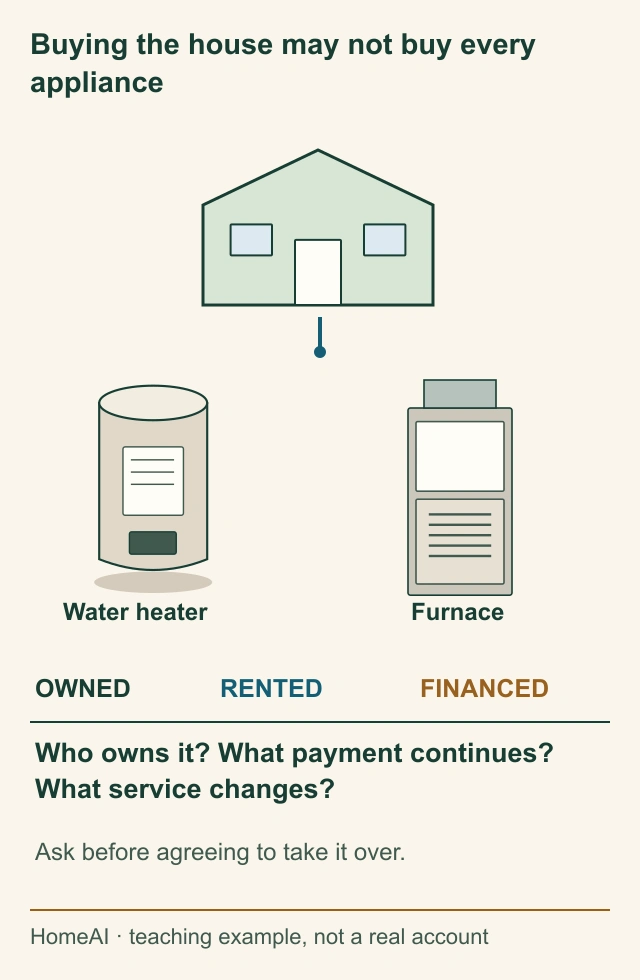
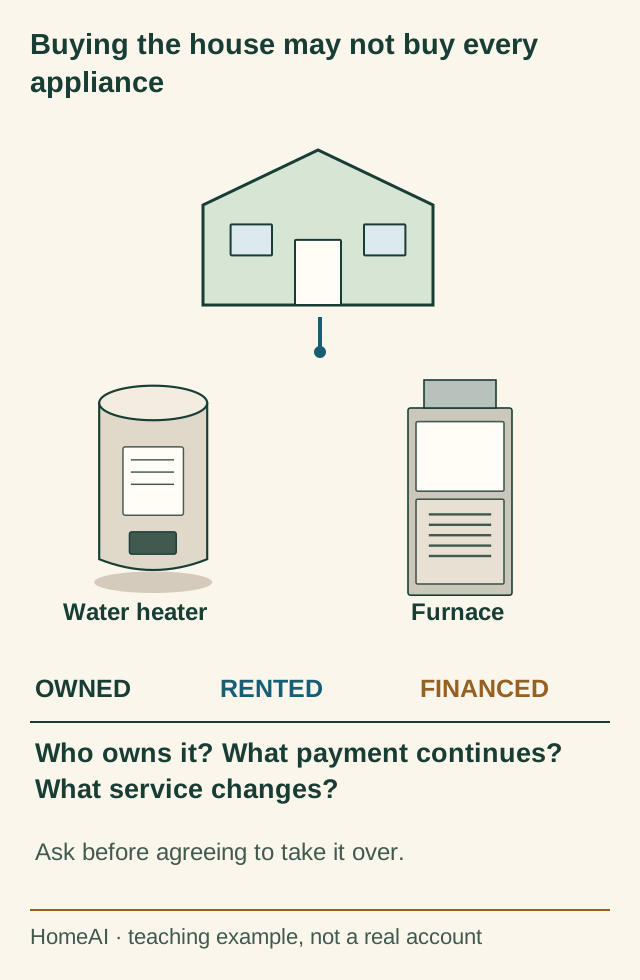
The physical appliance and the ownership or payment arrangement are separate. A furnace can heat the house while its actual agreement still needs to be understood before the purchase.
About this illustration
Illustrative relationships only. The actual unit and agreement determine who owns it and what is owed.
10 picture lessons appear beside the questions in this guide. Use them to understand the explanation, then consider what it means for your home.
Could the furnace or water heater still belong to someone else?
You can buy a house without buying every appliance inside it. A water heater, furnace, air conditioner or treatment system may be supplied under a rental agreement. You might instead find financed equipment, an owner-owned unit with a service plan, or several arrangements on one bill. Before you agree to take anything over, find out what is actually being offered: the equipment, a continuing payment, defined service coverage, or a combination.
That matters to your monthly budget and to your freedom to change the equipment. An inexpensive-looking monthly charge may continue under terms you have not seen. A buyout may transfer the existing appliance to you while changing who pays for repairs. Replacing the unit may involve both a contractor’s work and a separate agreement-ending process. The useful first question is simple: if I buy this home, what payments and responsibilities am I being asked to accept?
Start with the rooms, not a pile of unexplained documents. A water heater supplies hot water to taps. A furnace supplies heated air to rooms. A water-treatment appliance has its own water-quality task. Name each visible appliance, then ask whether it is owned, rented, financed or covered by a separate service agreement. An equipment-by-equipment list prevents one answer about the water heater from being stretched to everything beside it.
A seller saying the equipment is included is an important conversation starter, but your transaction documents and the actual supplier records need to agree. Ask your real estate lawyer or other locally appropriate legal professional to explain the purchase terms before an irreversible decision. Your real estate representative can help obtain information and communicate questions; an equipment inspection has the different job of assessing the physical system.
This guide explains how to make that enquiry understandable. Its supplier examples concern Enercare’s publicly served Ontario materials read on October 20, 2026. Its title-notice example is Ontario-specific. Another supplier, agreement, province or transaction can work differently. The photographs and annotated documents are teaching illustrations, not proof that a real appliance is rented or that a buyer has agreed to any terms.
Buying the house may not buy every appliance
The physical appliance and the ownership or payment arrangement are separate. A furnace can heat the house while its actual agreement still needs to be understood before the purchase.
Choose a part name to highlight its explanation below.
- The home
The home purchase needs an explicit account of the equipment.
- The appliances
A familiar unit can be owned, rented or financed.
- The obligations
Confirm what changes hands instead of inferring ownership from presence.
About this illustration
Illustrative relationships only. The actual unit and agreement determine who owns it and what is owed.
Start with the actual water heater and furnace
The tall tank heats domestic water; the adjacent furnace heats room air. Identify each appliance separately before asking which ownership, payment or service arrangement applies to it.
Choose a part name to highlight its explanation below.
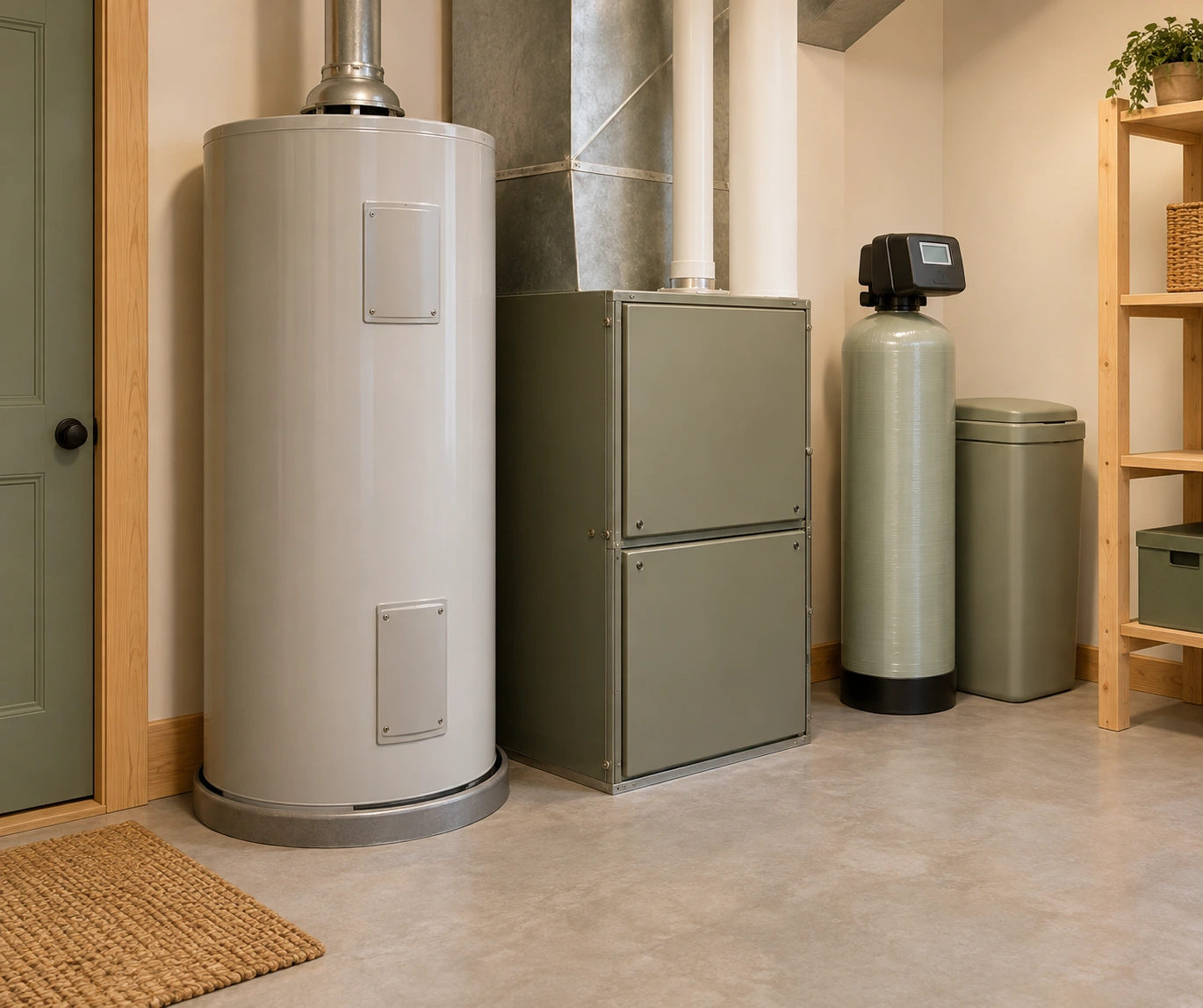
- Closed heater
Identify this appliance through safe records, not by opening it.
- Separate furnace
A nearby appliance is not automatically in the same agreement.
- Treatment equipment
One mechanical room can contain several distinct obligations.
About this illustration
No readable model, actual agreement, operating condition, equipment capacity or installation approval is supplied. Connections are not a complete plumbing or venting diagram.
Buying the house may not buy every appliance
The physical appliance and the ownership or payment arrangement are separate. A furnace can heat the house while its actual agreement still needs to be understood before the purchase.
- The home
- The home purchase needs an explicit account of the equipment.
- The appliances
- A familiar unit can be owned, rented or financed.
- The obligations
- Confirm what changes hands instead of inferring ownership from presence.
Read all the diagram text
- Buying the house may not buy every
- appliance
- Water heater
- Furnace
- OWNED
- RENTED
- FINANCED
- Who owns it? What payment continues?
- What service changes?
- Ask before agreeing to take it over.
- HomeAI · teaching example, not a real account
How do I know which appliance the agreement covers?
An agreement about a water heater is only useful when it has been matched to the water heater actually in the house. Ask for the supplier, appliance type, model, serial number and installation information, together with the complete agreement and any later amendments. If a combined bill lists several products, make separate entries. The furnace and water heater may have different installation dates and different obligations even when their charges arrive together.
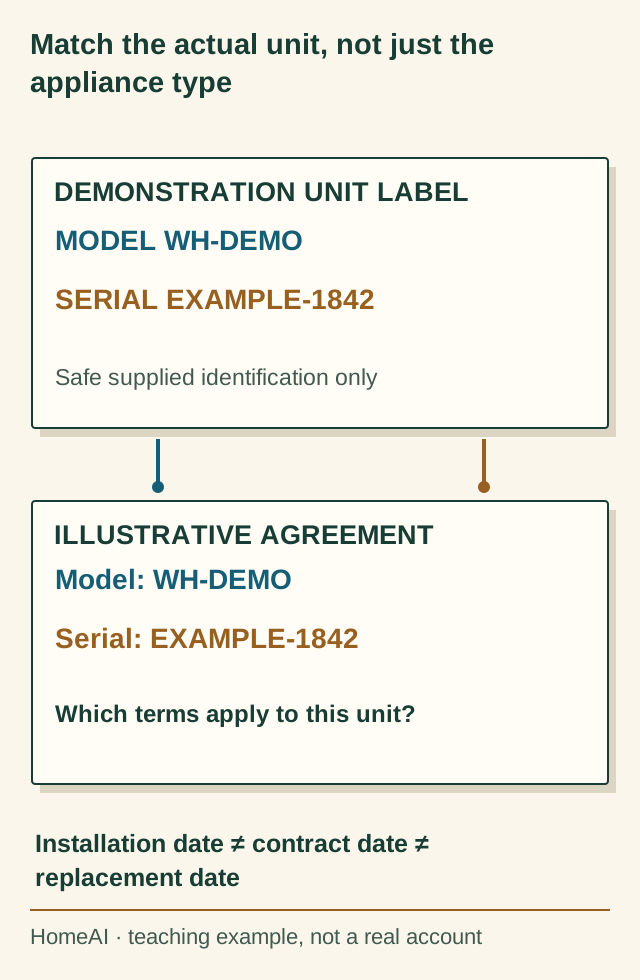
Use the label that belongs to the appliance, rather than a thermostat model, a sticker from a service visit or the house’s construction year. The annotated example pairs a demonstration serial number on a unit with the same demonstration number in a document. That is the task: establish that both records describe the same item. It is not a claim that a real supplier uses this form or that a familiar-looking tank has the same agreement as your neighbour’s.
Look only from ordinary safe access. Do not open a panel, move an appliance, disconnect anything or reach behind hazardous equipment to find a plate. If the identity cannot be read safely, ask the seller to have the supplier or qualified service provider identify it. A clear photograph supplied by an authorized person may help with matching; it does not establish operating condition or replace the assessment of the installed system.
Keep installation date, replacement date and contract date separate when the records do. A unit might have been exchanged after an earlier agreement began. An old folder may describe equipment that is no longer present. Ask the supplier which agreement and amendments govern the present unit, and how a replacement affected the obligations. Do not choose an online template merely because its date seems close.
Enercare’s current water-heater page links terms by installation period and buyout schedules by installation year. That makes the date-matching question concrete, but the public page is not your account’s written quotation. Request the applicable documents through the seller or an authorized representative. Account privacy still matters: viewing a house does not authorize a buyer to access the seller’s private account or change it.
If the labels and documents disagree, preserve the disagreement rather than filling the gap with a guess. A useful request is: please confirm which installed model and serial number this agreement covers, which terms apply, and whether any replacement or amendment changed it. That is easier for a supplier to answer than a broad question about whether all the equipment is included.
Match the actual unit, not just the appliance type
The same demonstration model and serial number link the illustrated equipment label to the agreement description. Installation, contract and replacement dates remain separate facts.
Choose a part name to highlight its explanation below.
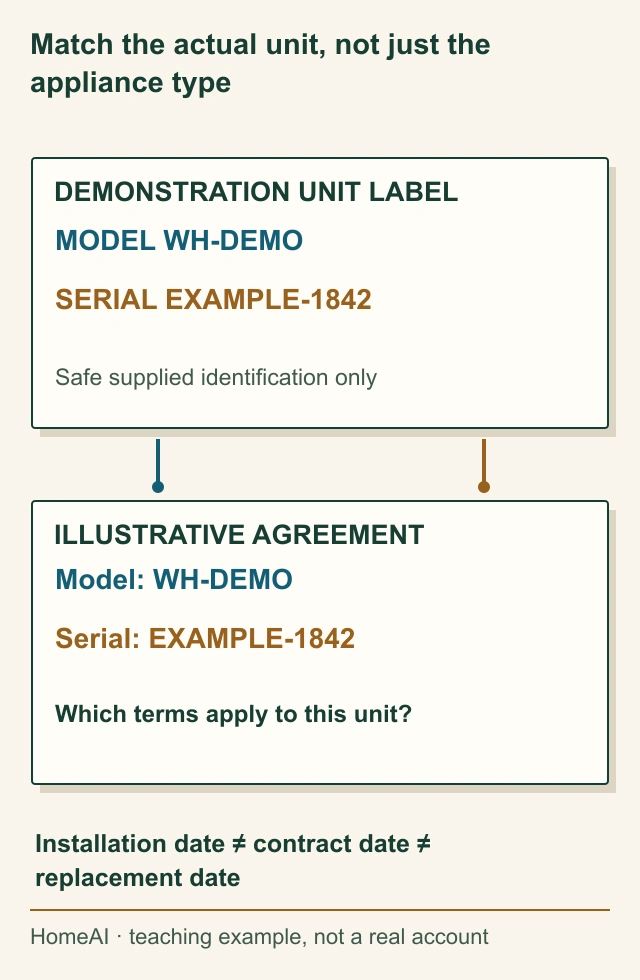
- Unit label
Example model WH-DEMO and serial EXAMPLE-1842 identify the illustrated unit only.
- Agreement description
The same sample fields show the matching task.
- Dates
Ask separately about installation, contract and later replacement.
About this illustration
All identifiers and document fields are invented examples, not a supplier form or proof of an actual match.
Match the actual unit, not just the appliance type
The same demonstration model and serial number link the illustrated equipment label to the agreement description. Installation, contract and replacement dates remain separate facts.
- Unit label
- Example model WH-DEMO and serial EXAMPLE-1842 identify the illustrated unit only.
- Agreement description
- The same sample fields show the matching task.
- Dates
- Ask separately about installation, contract and later replacement.
Read all the diagram text
- Match the actual unit, not just the
- appliance type
- DEMONSTRATION UNIT LABEL
- MODEL WH-DEMO
- SERIAL EXAMPLE-1842
- Safe supplied identification only
- ILLUSTRATIVE AGREEMENT
- Model: WH-DEMO
- Serial: EXAMPLE-1842
- Which terms apply to this unit?
- Installation date ≠ contract date ≠
- replacement date
- HomeAI · teaching example, not a real account
What am I paying for each month?
A bill can combine different things. A rental charge generally pays for the use of identified equipment under its terms. A financing charge is associated with a purchase or other financing arrangement. A protection or maintenance charge pays for a defined service product. Electricity or gas consumed by the appliance is another cost again. Adding them into one total does not make them one agreement or tell you which payments create ownership.
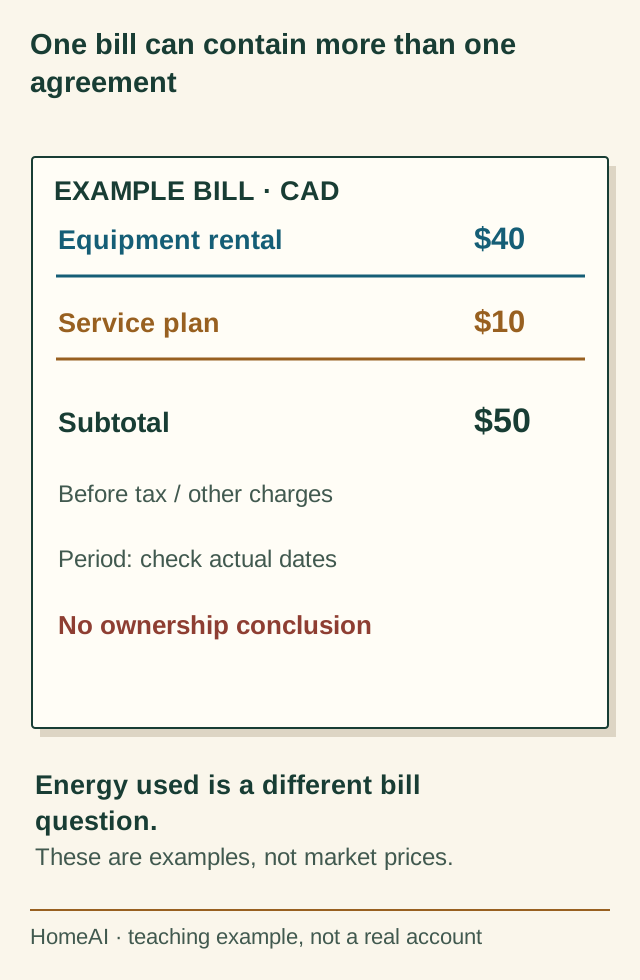
The sample bill in this guide separates a hypothetical $40 equipment charge and a hypothetical $10 service-plan charge. Its $50 subtotal is arithmetic, before any tax or other charge; it is not a supplier rate or an actual bill. The point is to ask what each line buys. If one item ends or changes at possession, the whole total may not follow it. A small-looking service line can have its own term and cancellation conditions.
Ask which charges recur, which are one-time, how tax is treated and whether there are outstanding amounts associated with the actual account. A zero balance on one statement does not establish equipment ownership: it may simply show that the statement has been paid. Conversely, a large total does not identify how much belongs to rental, financing, service or an earlier period. Ask for the lines to be reconciled before using the total as your ownership budget.
Check the duration and the mechanism for change. Does the agreement define a fixed period, a useful-life term, renewal or some other ending condition? Can the regular charge change under its provisions? Who provides the applicable written answer? A public current price or a seller’s old monthly amount should not be presented as a guaranteed future rate. If a future amount is unknown, call it unknown rather than disguising it as a precise forecast.
The first bill after closing may also describe less than a normal billing period. Enercare’s current moving FAQ says its incoming rental bill can be prorated from the move date to the period end. That is a named-supplier example, not a rule for every Canadian account. Compare dates, equipment and line items before deciding that a partial-month figure is your normal monthly cost.
Keep the equipment-payment question separate from utility consumption. Buying out a rented furnace does not by itself tell you how much gas the building will use. Replacing a water heater does not prove a saving from one lower bill. Equipment performance, household use, weather and energy tariffs belong in a different comparison. The existing energy-bill and equipment guides can help you read those quantities without mixing them with the rental decision.
One bill can contain more than one agreement
This invented bill separates $40 of equipment rental from $10 of service coverage. The $50 subtotal is before tax and other charges; neither line proves ownership of the appliance.
Choose a part name to highlight its explanation below.
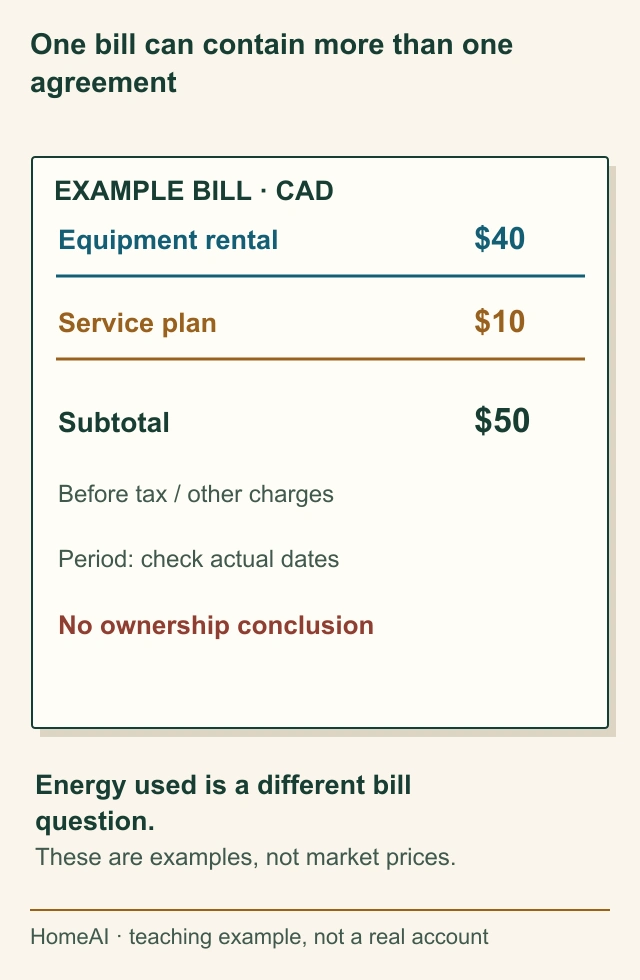
- Rental line
Example $40 CAD for equipment use under the applicable agreement.
- Service line
Example $10 CAD for a separate defined service product.
- Subtotal
$40+$10=$50 CAD before tax; energy consumption and other amounts are not included.
About this illustration
Invented Canadian-dollar arithmetic. No real supplier rates, tax treatment or actual account is represented.
One bill can contain more than one agreement
This invented bill separates $40 of equipment rental from $10 of service coverage. The $50 subtotal is before tax and other charges; neither line proves ownership of the appliance.
- Rental line
- Example $40 CAD for equipment use under the applicable agreement.
- Service line
- Example $10 CAD for a separate defined service product.
- Subtotal
- $40+$10=$50 CAD before tax; energy consumption and other amounts are not included.
Read all the diagram text
- One bill can contain more than one
- agreement
- EXAMPLE BILL · CAD
- Equipment rental
- $40
- Service plan
- $10
- Subtotal
- $50
- Before tax / other charges
- Period: check actual dates
- No ownership conclusion
- Energy used is a different bill
- question.
- These are examples, not market prices.
- HomeAI · teaching example, not a real account
The bill lines do different jobs
- Equipment useA rental charge under the actual unit’s agreement.
- Purchase financingA financing obligation whose actual documents explain ownership and security.
- Service coverageDefined work/support with its own terms.
- Energy consumedFuel or electricity used by the equipment; a separate quantity and tariff question.
Descriptions are enquiry categories, not classifications of a real account.
Further reading: Enercare · Water heater terms and conditions; Ontario · Door-to-door sales and home service contracts.
Does the plan cover the whole repair?
The phrase service included needs a second question: service to what, under which conditions? An agreement may identify an appliance while surrounding pipes, venting, drains, wiring, access work and damaged finishes have their own responsibilities. This does not mean that every plan excludes those items. It means you need the actual coverage and exclusions before treating a general promise as a complete repair budget.
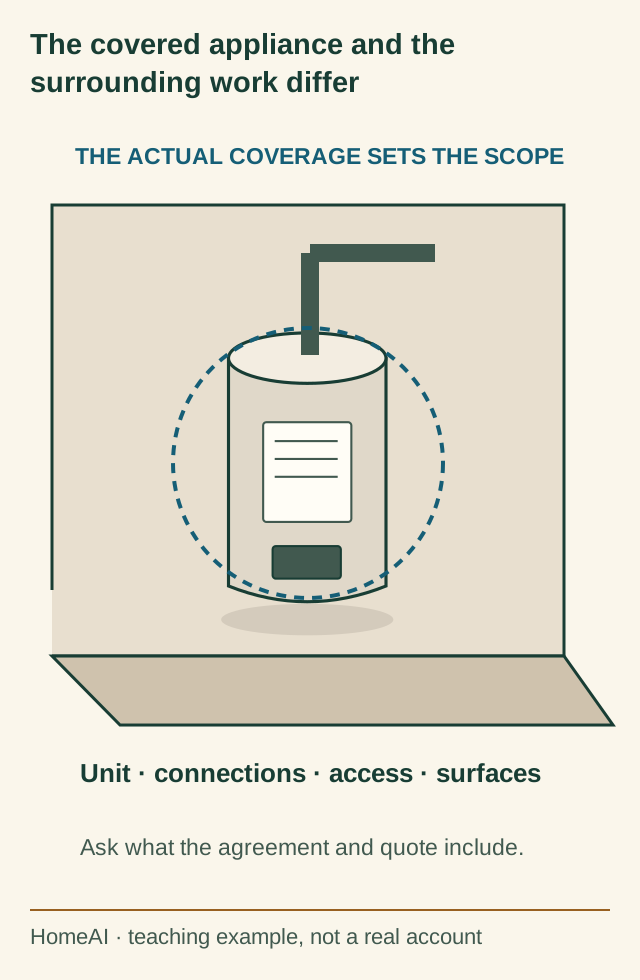
The room illustration makes the distinction physical. The tank is one component; a vent or other connection belongs to a larger installed system; the floor and wall are parts of the building. Work at one can affect another. Ask the provider to describe the covered unit, the problem reported, the work included and anything requiring separate authorization. A technician attending the appliance is not the same as a commitment to rebuild the room around it.
Ask what happens with a service visit, a worn part, an appliance replacement and work outside ordinary coverage. Which calls or parts are covered? Are there exclusions or chargeable work that need approval? Who arranges access? If the appliance is replaced, how are changes to the surrounding installation handled? Obtain answers under the actual agreement rather than importing a supplier’s marketing comparison or an example repair price.
Physical safety and contract coverage are separate decisions. A service plan cannot make an unsafe installation acceptable, and a coverage dispute should not become a reason to use equipment contrary to immediate safety advice. Keep enclosures closed, follow the appliance’s actual instructions and use the appropriate emergency or qualified service response for an active hazard. This guide does not teach gas, electrical, venting or plumbing work.
A repair invoice also has limits. It may show that a particular part was replaced on a particular date, while leaving the rest of the appliance and surrounding system outside that job. For a purchase, connect the invoice with the inspection findings and ask what remains to be assessed. Avoid two opposite shortcuts: a recent service does not establish everything is sound, and a service visit does not automatically mean the appliance needs replacement.
When comparing rental with ownership, this is where the two options can stop being equivalent. A buyout might leave you responsible for future maintenance and repairs to the existing unit, subject to whatever rights and coverage actually remain. Enercare’s current rental-versus-buyout page describes that change for its program. Do not use that description as the terms of another supplier’s plan; ask for the actual effect on your unit and any transferable warranty.
The covered appliance and the surrounding work differ
The tank, nearby connection, wall and floor are separate parts of the job. Read the actual coverage before assuming an appliance service agreement also pays for every surrounding repair.
Choose a part name to highlight its explanation below.
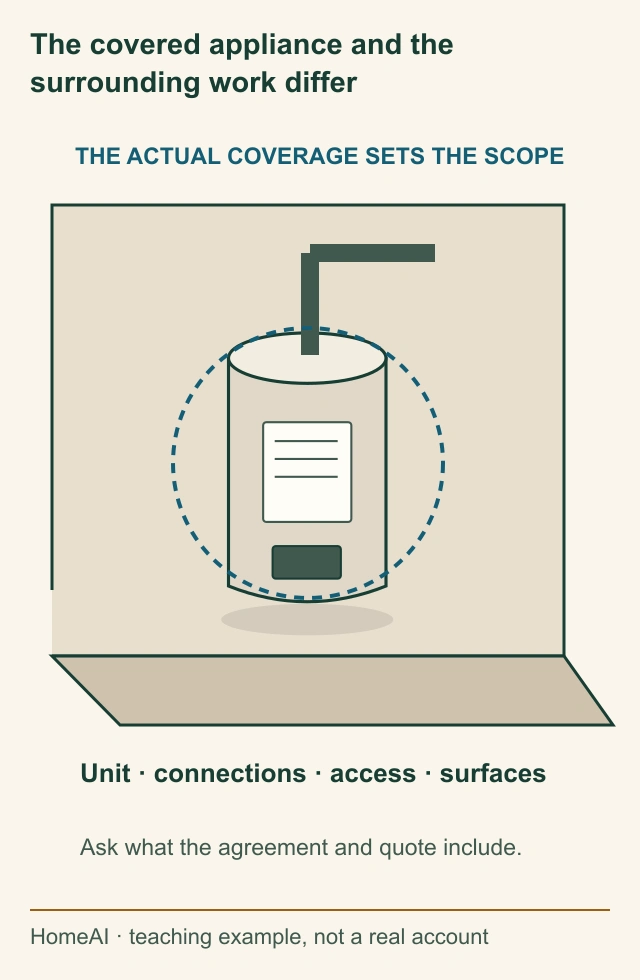
- Appliance
Identify the unit and the service promised for it.
- Connections
Ask whether the quoted work includes relevant surrounding installation work.
- Room surfaces
Access and making good may be separate questions; do not assume coverage.
About this illustration
The drawing assigns no actual inclusions, exclusions, pipe route or safe installation. The applicable agreement and qualified assessment supply those answers.
The appliance sits within a larger installation
The closed heater, neighbouring furnace, air plenum and electrical cabinet illustrate different parts of a mechanical room. An agreement for one unit needs its actual scope; it should not be assumed to cover every surrounding component or repair.
Choose a part name to highlight its explanation below.
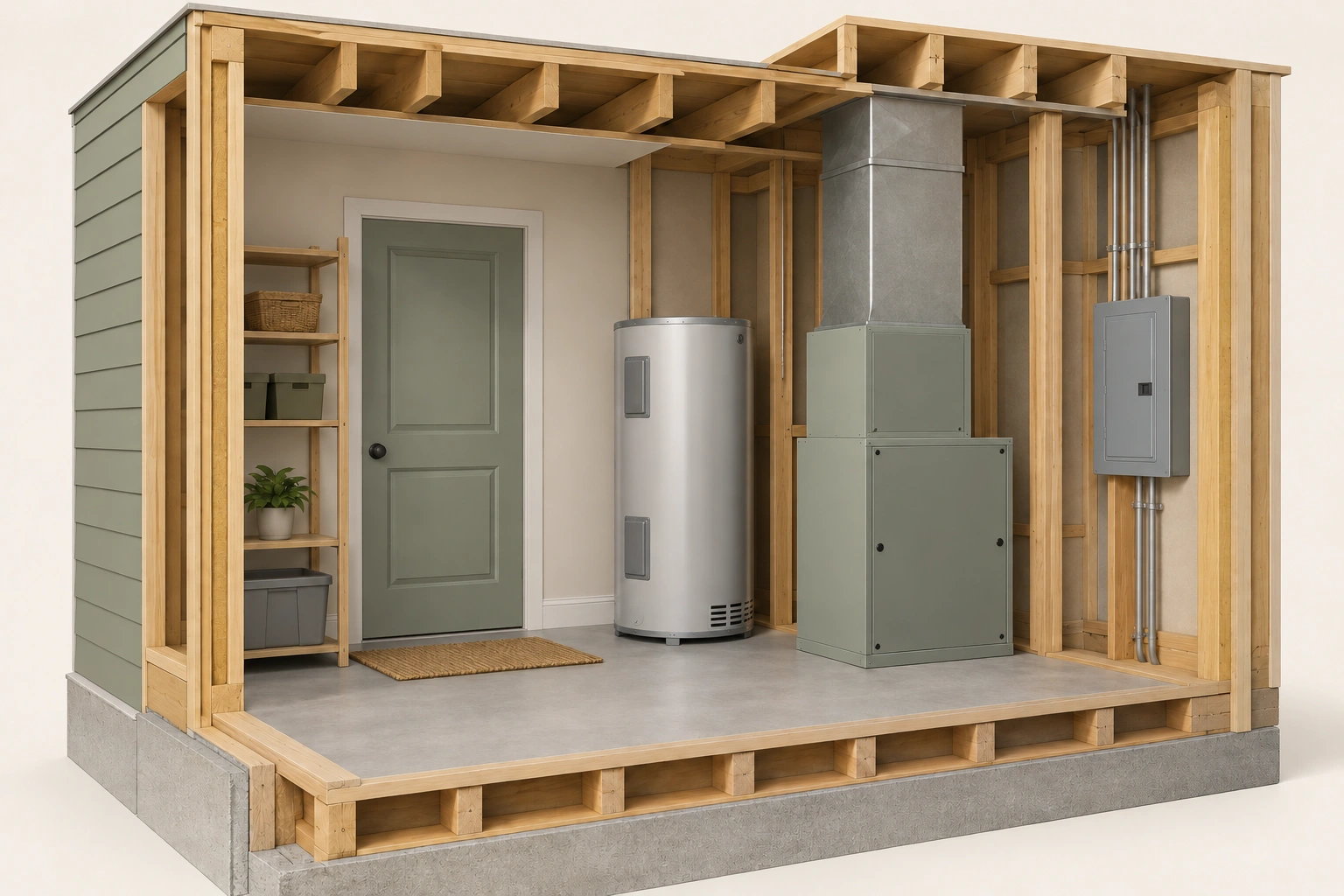
- Closed heater
Match covered appliance work to the exact agreement.
- Furnace and plenum
Nearby equipment remains a separate scope enquiry.
- Closed electrical cabinet
Keep it closed and obtain qualified technical assessment.
About this illustration
No water, gas, exhaust or electrical circuit topology, service clearance, condition, rating or approved installation is established. Do not imitate the room layout.
The covered appliance and the surrounding work differ
The tank, nearby connection, wall and floor are separate parts of the job. Read the actual coverage before assuming an appliance service agreement also pays for every surrounding repair.
- Appliance
- Identify the unit and the service promised for it.
- Connections
- Ask whether the quoted work includes relevant surrounding installation work.
- Room surfaces
- Access and making good may be separate questions; do not assume coverage.
Read all the diagram text
- The covered appliance and the
- surrounding work differ
- THE ACTUAL COVERAGE SETS THE SCOPE
- Unit · connections · access · surfaces
- Ask what the agreement and quote include.
- HomeAI · teaching example, not a real account
What happens to the agreement when the house changes hands?
A home sale involves more than changing the name on an equipment bill. The purchase terms describe what the buyer and seller have agreed. The equipment agreement describes the supplier relationship. Supplier administration then needs the applicable information and documents. Those pieces should line up before everyone treats the handover as finished.
Enercare’s current moving page asks buyers to check the Agreement of Purchase and Sale for rental equipment and describes use of that agreement or an Assumption Agreement in its transfer process. It also tells sellers to involve their real estate lawyer. These are useful examples of why the equipment needs attention during the transaction; they are not a universal transfer clause or a substitute for advice about what your purchase agreement requires.
Ask the seller or authorized representative to obtain the actual supplier process early enough for your decision. Which equipment and agreement are proposed to transfer? What documentation does the supplier require? What date applies? What remains for the seller to settle? What confirmation should each party receive? The answers should identify the unit, rather than describing an entire mechanical room vaguely.
Keep a request, acknowledgement and completion confirmation distinct. Sending information starts an administrative task; an acknowledgement may only mean that it was received. A final statement should explain what the provider has done and what remains. Your legal professional can tell you how a missing confirmation affects the transaction. Do not describe a pending request as an accepted transfer.
A missing or disputed rental item is not something to solve by silently changing the paperwork after the event. Give the actual documents to your legal professional and ask the supplier for its position through known channels. Have the disagreement explained before relying on an assumption about who must pay. A website cannot decide whether a particular buyer has legally assumed an agreement.
If the property is tenanted, add another distinction: owner, bill payer and person allowed to arrange service may be different. Enercare’s current page publishes a specific September 21, 2026 policy for new tenancy changes and landlord billing, while distinguishing existing tenant accounts and service contacts. Ask which arrangement applies to the actual account. Do not turn this supplier policy into a rule for all landlords or all Canadian rental equipment.
A request is not the completed handover
The purchase terms, the supplier’s requirements and the resulting confirmation do different jobs. Keep the equipment identity and agreed date attached as the process moves from a proposal to the actual outcome.
Choose a part name to highlight its explanation below.
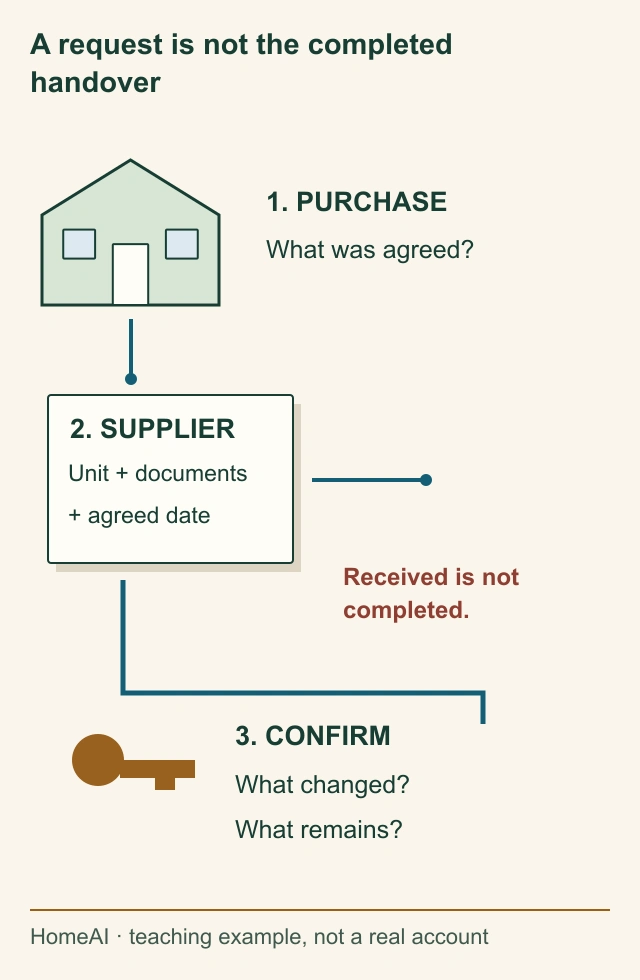
- Purchase terms
Have the legal professional explain what the buyer and seller agreed.
- Supplier requirements
Obtain the applicable authorized process and unit details.
- Result
Keep the actual confirmation rather than treating an acknowledgement as completion.
About this illustration
An enquiry journey, not a universal transfer process or a finding that a buyer assumed an agreement.
A request is not the completed handover
The purchase terms, the supplier’s requirements and the resulting confirmation do different jobs. Keep the equipment identity and agreed date attached as the process moves from a proposal to the actual outcome.
- Purchase terms
- Have the legal professional explain what the buyer and seller agreed.
- Supplier requirements
- Obtain the applicable authorized process and unit details.
- Result
- Keep the actual confirmation rather than treating an acknowledgement as completion.
Read all the diagram text
- A request is not the completed
- handover
- 1. PURCHASE
- What was agreed?
- 2. SUPPLIER
- Unit + documents
- + agreed date
- Received is not
- completed.
- 3. CONFIRM
- What changed?
- What remains?
- HomeAI · teaching example, not a real account
Can I buy the equipment, end the agreement or replace it?
These are three different proposals. A buyout purchases the existing equipment under the applicable terms. Ending an agreement deals with that agreement’s ending provisions. Replacement is physical work that removes or changes equipment and installs something else. A proposal can involve more than one of these, so the contractor’s scope and the supplier’s confirmation both matter.
Ask for a dated, equipment-specific buyout quotation if you are considering ownership of the existing unit. Find out what the amount includes, how long the quote applies, what happens to any separate service product and who becomes responsible for future maintenance and repair. Paying to acquire an old appliance does not install a new one. An attractive amount is only one part of understanding what you will own.
If you are considering cancellation or another ending route, ask the supplier to identify the actual provisions and the steps it requires. Do not assume that a right or deadline described for a new consumer contract automatically applies to a home buyer taking over an older arrangement. The formation date, transaction and jurisdiction matter. If the terms or their application are disputed, obtain independent legal advice.
If replacement is proposed, obtain a proper installation scope from the qualified contractor and a separate explanation of the old agreement. Ask who is handling the supplier communication, any permitted return or collection, and the final account confirmation. A disconnected appliance, an empty place on the floor or a contractor’s paid invoice does not by itself establish that the former agreement has ended.
Enercare’s current page expressly describes a return process for its rental water heaters and says termination follows the actual contract. The important lesson here is the existence of an equipment-and-account process, not a removal procedure to copy. Do not disconnect or transport rented equipment yourself on the strength of this guide. Arrange the work and supplier requirements through the appropriate authorized people.
When a seller offers to buy out or remove equipment before closing, ask your legal professional what wording and confirmation will establish the agreed result. The buyer needs to know whether the final position is ownership of the existing unit, a properly ended arrangement, a replacement with a new agreement, or something still unresolved. A promise and a completed outcome are different things.
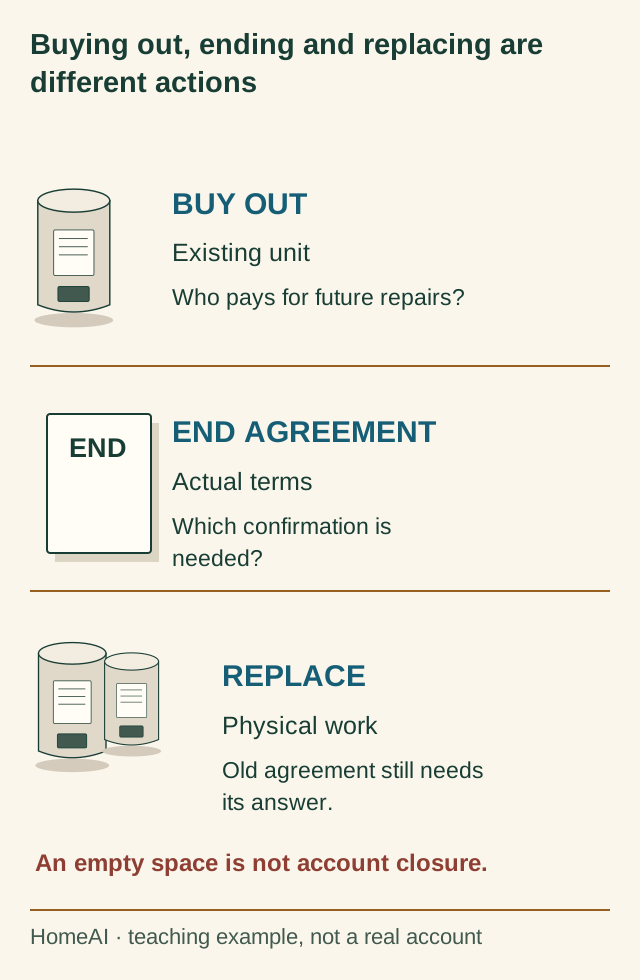
Buying out, ending and replacing are different actions
Buying the existing unit changes the ownership question. Ending deals with agreement terms. Replacing changes the physical equipment, while the old supplier arrangement still needs resolution.
Choose a part name to highlight its explanation below.
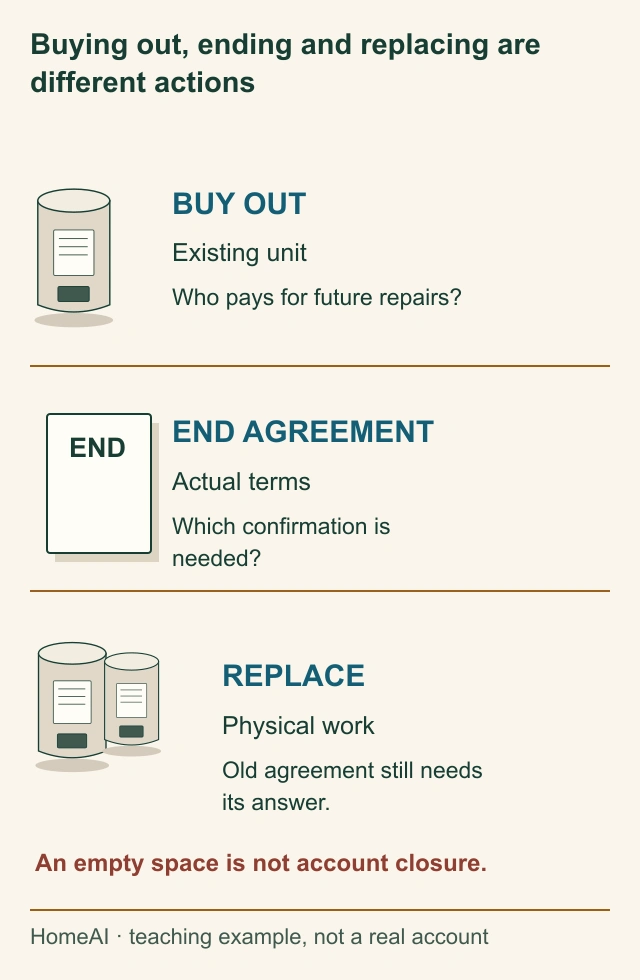
- Buy out
Acquire the existing unit under the applicable quotation and terms.
- End
Follow the actual agreement’s ending provisions and confirmations.
- Replace
Arrange the physical work and the separate old-agreement resolution.
About this illustration
No actual ending right, price, contractor scope or supplier acceptance is established.
Buying out, ending and replacing are different actions
Buying the existing unit changes the ownership question. Ending deals with agreement terms. Replacing changes the physical equipment, while the old supplier arrangement still needs resolution.
- Buy out
- Acquire the existing unit under the applicable quotation and terms.
- End
- Follow the actual agreement’s ending provisions and confirmations.
- Replace
- Arrange the physical work and the separate old-agreement resolution.
Read all the diagram text
- Buying out, ending and replacing are
- different actions
- BUY OUT
- Existing unit
- Who pays for future repairs?
- END
- END AGREEMENT
- Actual terms
- Which confirmation is
- needed?
- REPLACE
- Physical work
- Old agreement still needs
- its answer.
- An empty space is not account closure.
- HomeAI · teaching example, not a real account
Name the proposed ending
- BuyoutPurchase the existing unit under applicable terms.
- TerminationEnd the agreement under its actual provisions.
- ReplacementTechnical work plus the old agreement enquiry.
- ReturnPhysical handling and supplier process, not automatic account clearance.
The named supplier example is not a universal contract.
Further reading: Enercare — Water heater terms and conditions; Enercare — Residential Water Heater Agreement, SAMPLE EC.506_B.FOR(NOV/22).
Does Ontario’s NOSI change wipe out the rental?
No automatic conclusion about the equipment contract follows from that title change. A Notice of Security Interest, or NOSI, was a notice on land title concerning an interest in a fixture. ServiceOntario explains that Ontario banned registration of consumer-goods NOSIs on June 6, 2024 and deemed existing consumer NOSIs expired. The title notice and the underlying equipment agreement are different matters.
The current ServiceOntario page expressly says the ban does not cancel an existing fixture contract or eliminate the business’s underlying interest in the fixture. That is why a seller’s statement that the notice expired cannot be treated as proof the water heater is now owned free of obligations. Ask your legal professional to assess the actual title entry and the actual agreement together.
ServiceOntario also distinguishes consumer from commercial NOSIs. Do not apply the residential consumer explanation to every entry with a similar name or to a mixed-use or commercial situation without advice. Nor should an Ontario land-title explanation be presented as the registry rules in another province. Keep the place, type of equipment, document and current legal advice attached to the conclusion.
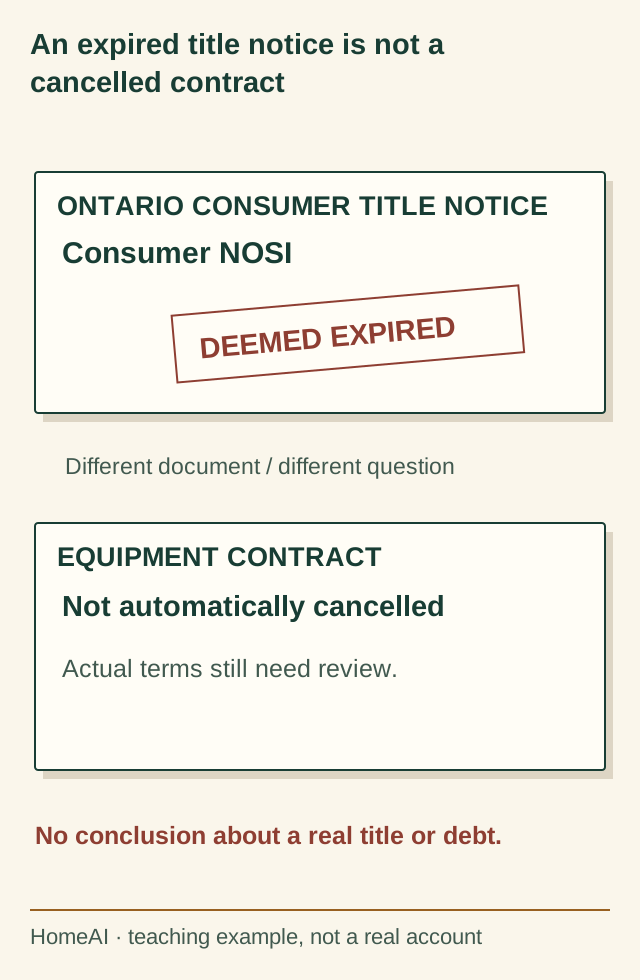
The illustration deliberately shows two separate documents: a consumer title-notice question and an equipment-contract question. It does not depict a court decision, cleared real title or cancelled real debt. You should be able to explain the distinction in ordinary language: changing the effect of one notice does not, by itself, answer what the equipment agreement still requires.
If someone uses a title concern to pressure you into a new agreement, removal service or financing proposal, pause and seek independent advice. The current Ontario consumer pages warn about pressure and explain their particular consumer-protection scope. They are not grounds for a reader to declare a specific contract unenforceable. Ask the lawyer handling your purchase what the documents establish and what action, if any, is appropriate.
An expired title notice is not a cancelled contract
Ontario’s consumer-NOSI change concerns the title notice. The current official guidance separately says an existing fixture contract and underlying fixture interest are not automatically cancelled by that ban.
Choose a part name to highlight its explanation below.
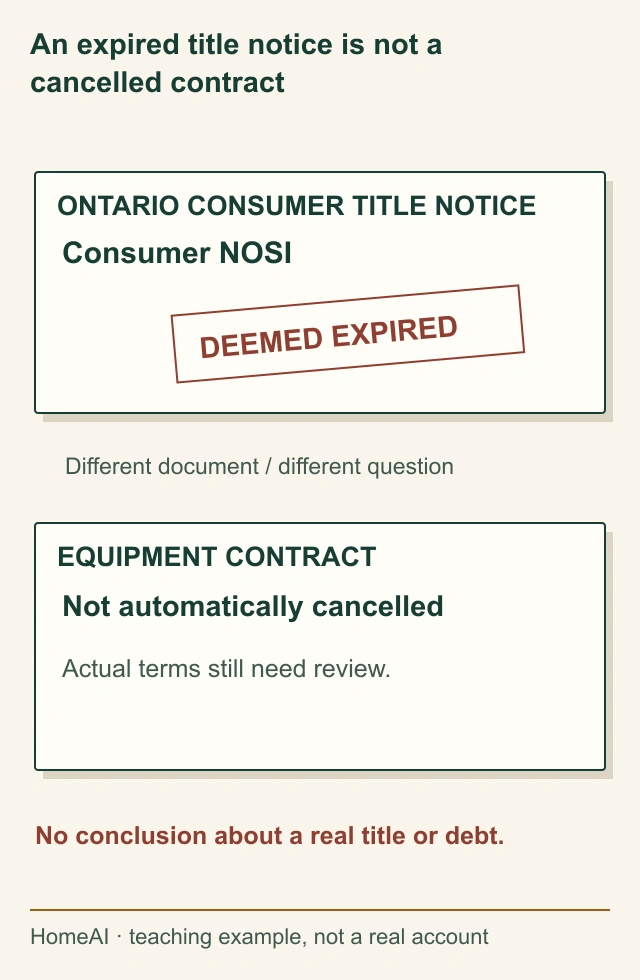
- Title notice
Ontario deemed consumer NOSIs expired; the official scope matters.
- Equipment contract
The notice change does not automatically cancel the underlying fixture contract.
- Actual advice
Give both documents to the transaction’s legal professional.
About this illustration
Ontario consumer-goods explanation only, not a title search, legal ruling or assessment of a commercial notice or another province.
An expired title notice is not a cancelled contract
Ontario’s consumer-NOSI change concerns the title notice. The current official guidance separately says an existing fixture contract and underlying fixture interest are not automatically cancelled by that ban.
- Title notice
- Ontario deemed consumer NOSIs expired; the official scope matters.
- Equipment contract
- The notice change does not automatically cancel the underlying fixture contract.
- Actual advice
- Give both documents to the transaction’s legal professional.
Read all the diagram text
- An expired title notice is not a
- cancelled contract
- ONTARIO CONSUMER TITLE NOTICE
- Consumer NOSI
- DEEMED EXPIRED
- Different document / different question
- EQUIPMENT CONTRACT
- Not automatically cancelled
- Actual terms still need review.
- No conclusion about a real title or debt.
- HomeAI · teaching example, not a real account
How do I compare the real cost of my options?
Compare the same purpose over the same period. Do you want continued hot-water service, ownership of the existing unit, or a different appliance? List the actual dated quotations, the agreement consequences and the work scope. A rental total and a replacement quote may buy different things. Comparing their headline numbers without those differences can make an apparently cheap option misleading.
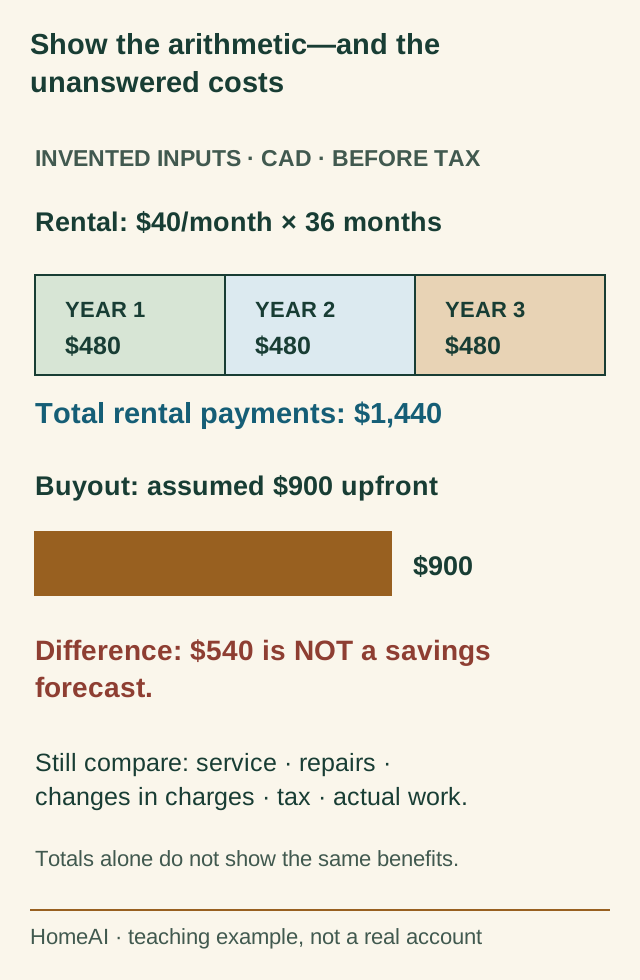
Here is a deliberately invented arithmetic example, not a supplier offer. At an assumed unchanged rental charge of $40 per month, 36 months adds to $1,440 before tax: 40 multiplied by 36. A hypothetical $900 buyout is $540 less than that rental total. That subtraction is not a saving forecast. It leaves unanswered what happens to coverage, repairs, the appliance’s future condition, separate service fees and any change in the monthly charge.
Place known amounts and unresolved amounts in different places. Known for the example means an amount explicitly assumed for the arithmetic; known for your real comparison means a usable quotation or confirmed charge. Do not give an unknown repair bill an invented value just to make a chart complete. If you set aside a contingency, label it as money reserved rather than a bill already incurred.
Now add the replacement option. A contractor’s quotation needs an identified appliance and installation scope, including the surrounding work that applies to that property. The former supplier relationship still needs its own resolution. The new equipment may also have maintenance and service conditions. Do not call replacement the winner until the decision includes those responsibilities and the household’s actual needs.
Time matters as well as the amount. A buyout may require cash now while rental payments arrive over time. A charge quoted for one date may change before closing. A unit’s condition can affect whether continued ownership is practical, but a general article cannot predict its remaining life. Ask the supplier, qualified equipment assessor and legal professional their different questions, then bring the answers into one comparison.
The useful outcome is an understandable choice, not a manufactured break-even date. You should know what you pay at the start, which charges continue, what service changes, what work is included and what remains uncertain. Keep a separate energy-use comparison if efficiency is part of the replacement proposal. Rental ownership and fuel consumption are related budget topics, but they are not the same calculation.
The arithmetic and the unanswered costs
Assuming an unchanged $40 monthly rental, 36 months totals $1,440 before tax. A hypothetical $900 buyout differs by $540, but that difference is not a savings forecast because responsibilities and other future costs may change.
Choose a part name to highlight its explanation below.
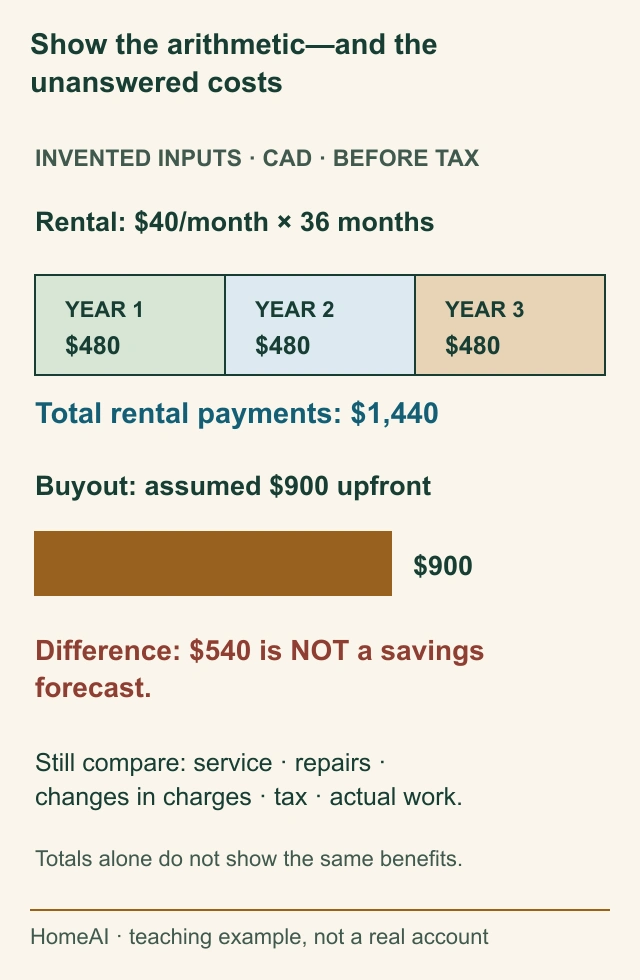
- Rental assumption
Assuming $40 CAD per month stays unchanged, 36 months totals $1,440 CAD before tax.
- Buyout example
An invented $900 CAD upfront buyout would purchase the existing unit.
- Difference and unknowns
The $540 CAD difference does not predict savings. Service, repairs, tax, charge changes and the work included may differ.
About this illustration
Invented inputs, unchanged monthly-charge assumption, 36-month comparison and tax omitted. No actual quote, repair forecast, remaining-life estimate or recommendation.
Show the arithmetic—and the unanswered costs
Assuming an unchanged $40 monthly rental, 36 months totals $1,440 before tax. A hypothetical $900 buyout differs by $540, but that difference is not a savings forecast because responsibilities and other future costs may change.
- Rental assumption
- Assuming $40 CAD per month stays unchanged, 36 months totals $1,440 CAD before tax.
- Buyout example
- An invented $900 CAD upfront buyout would purchase the existing unit.
- Difference and unknowns
- The $540 CAD difference does not predict savings. Service, repairs, tax, charge changes and the work included may differ.
Read all the diagram text
- Show the arithmetic—and the
- unanswered costs
- INVENTED INPUTS · CAD · BEFORE TAX
- Rental: $40/month × 36 months
- YEAR 1
- $480
- YEAR 2
- $480
- YEAR 3
- $480
- Total rental payments: $1,440
- Buyout: assumed $900 upfront
- $900
- Difference: $540 is NOT a savings
- forecast.
- Still compare: service · repairs ·
- changes in charges · tax · actual work.
- Totals alone do not show the same benefits.
- HomeAI · teaching example, not a real account
Put unknowns beside the quoted amount
- ContinueRegular charge, ability to change, period, coverage and ending terms.
- Buy outDated price for the existing unit plus the responsibilities and coverage that change.
- ReplaceQuoted installation scope and separate resolution of the former supplier arrangement.
No economic winner, predicted repair bill, current supplier rate or personal financial recommendation.
Further reading: Enercare · Water heater terms and conditions; Ontario · Door-to-door sales and home service contracts.
What if a bill arrives and the paperwork is missing?
First identify what the bill says it is charging for, which appliance and address it describes, and which dates it covers. Compare it with the documents you actually received. It might be a partial period, a separate plan, a unit you expected to own, or an item that was not clearly resolved. Those possibilities need explanation; the arrival of an envelope does not settle the legal question.
Ask the supplier through a known official channel for the agreement and equipment information it relies on, and give your legal professional the purchase documents and correspondence. Enercare’s current moving FAQ directs buyers with missing rental or assumption information to contact it and discusses the role of purchase documents. That is a current named-supplier process, not a decision about who owes a disputed amount in your case.
Do not let a general online comment tell you to ignore a bill, make a payment to prove a point, or sign an agreement without understanding the effect. Ask your legal professional about deadlines and the appropriate response. A payment, signature or account change may have consequences that depend on the actual facts and agreement. This guide supplies neither a dispute ruling nor a tactic for avoiding an obligation.
Keep the enquiry focused. For example: the supplied serial number does not match the equipment description; please explain the replacement history and applicable agreement. Or: this statement contains a service line we did not understand; please identify its terms and proposed transfer. A precise question helps separate a document gap from a physical equipment problem.
If there is also a heating or hot-water problem, arrange appropriate service and immediate safety action separately. Billing uncertainty does not diagnose the appliance or replace its emergency instructions. Likewise, a successful service visit does not resolve who owns it. Once the supplier responds, compare its answer with the actual documents rather than treating a reassuring phone conversation as the whole result.
What should I have before and after closing?
Before committing to an equipment arrangement, aim to understand the appliances involved, their safely confirmed identities, the complete applicable terms, current charges and the proposed treatment in your purchase. Give unresolved points to your legal professional while there is still time to address them. A recent service sticker or a broad listing phrase is not a substitute for the applicable documents.
For an agreed transfer, keep the supplier’s required documents and the resulting confirmation with the actual closing information. For an agreed buyout or ending, keep the equipment-specific quotation, proof of the agreed payment or action and confirmation of the resulting position. If work is also happening, retain the contractor’s scope and completion records separately. Each record should help you understand what happened, not merely add another page.
After possession, compare the first statement with the equipment, start date, service products and amounts you expected. Ask about any difference rather than assuming that the first total is your usual monthly cost. Store the actual equipment manual and appropriate service contact where the household can use them. Someone who needs service should not have to reconstruct the purchase just to identify the appliance.
For a seller, organize the same information before listing: what is rented or financed, what is separately serviced, the unit identities, and how the proposed sale handles each. A clear account of the equipment helps the buyer ask useful questions and helps your legal professional coordinate the transaction. Do not promise cancellation or ownership transfer before the required process is understood.
For any buyer, the final practical test is whether you can explain the arrangement without jargon. This is the water heater; this is who owns it; this is what I am being asked to pay; this is the service coverage I have actually confirmed; and this is what happens if I want a change. If one part is still unanswered, name it plainly and obtain the appropriate answer. You do not need to become a contract expert to recognise an important gap.
Keep learning about the connected parts
- Buying a home with solar: understand the system and agreements
- Your water heater: build the right maintenance record
- Before you make an offer: what to check, who to ask
- Cash required for closing: deposit, advance, adjustments and deadlines
- Shared heating and district energy: follow the service boundary into the home
- Buying a home on leased land: identify the home, site and continuing rights
Canadian context and authorities · Visual atlas · Learning labs
Know the parts.
Know what the words mean.
- Equipment rental
- An arrangement to use identified equipment under its terms. Regular payments do not automatically make it yours.
- Equipment finance
- A payment arrangement connected to a purchase or other financing. Read the documents to understand ownership, security and ending conditions.
- Service agreement
- An agreement for defined support or work. It may be separate from who owns the appliance.
- Buyout quotation
- A dated price and terms for buying the identified existing equipment; it is not a new appliance installation quote.
- Agreement transfer
- The applicable process for another person to take on identified rights and obligations.
- NOSI
- A notice of security interest on land title. Ontario’s consumer-goods changes do not automatically cancel an equipment contract.
- Authorized supplier request
- An enquiry made by the account holder or someone properly allowed to act for them; a house viewing does not provide that authority.
- Prorated charge
- A charge calculated for part of a period rather than the full usual period; the actual account’s method and dates matter.
Questions to bring
to the conversation.
- Which appliances are owned, rented, financed or separately serviced?
- What do the actual monthly charges buy, and which terms govern a change?
- Which equipment-specific documents and confirmations resolve the agreed handover?
Separate a showing observation, an existing record and a new professional assessment. Unknown means a question remains; it does not automatically mean a defect.
Use the evidence planner ↗Go to the source.
Original HomeAI explanation informed by these public references. Sources support the underlying guidance; they have not reviewed or endorsed HomeAI. Diagrams are conceptual, and calculator outputs depend on your inputs.
Supplier examples use Enercare’s Ontario pages read October20,2026. Ontario’s consumer title-notice and home-service guidance has its stated provincial scope. The linked November2022SAMPLE agreement retains its previously recorded watermark limits. Use your actual agreement, equipment assessment and local legal advice; this guide cannot determine a real account obligation or transaction outcome.
Publication & source review
First published .
Sources reviewed .
- ServiceOntario — Notices of Security Interest
- Enercare — Water heater terms and conditions
- Enercare — Residential Water Heater Agreement, SAMPLE EC.506_B.FOR(NOV/22)
- ServiceOntario · Notices of Security Interest
- Enercare · Water heater terms and conditions
- Enercare · Moving: rental equipment and account handover
- Ontario · Door-to-door sales and home service contracts
Have a question about your home?
Start with the symptom, timing and what you have observed.
Ask HomeAI