- Separate household supply, internal wash-water circulation, outgoing discharge and drying. Success or a symptom in one does not establish every other function.
- Spray reach, filtration, product delivery and the chosen cycle affect different parts of the cleaning question. Drying adds its own surface, moisture and model-specific relationships.
- Use the actual model’s documents and ordinary observations to choose appliance, plumbing or electrical scope. Interior condensation cannot clear retained water or moisture outside the appliance.
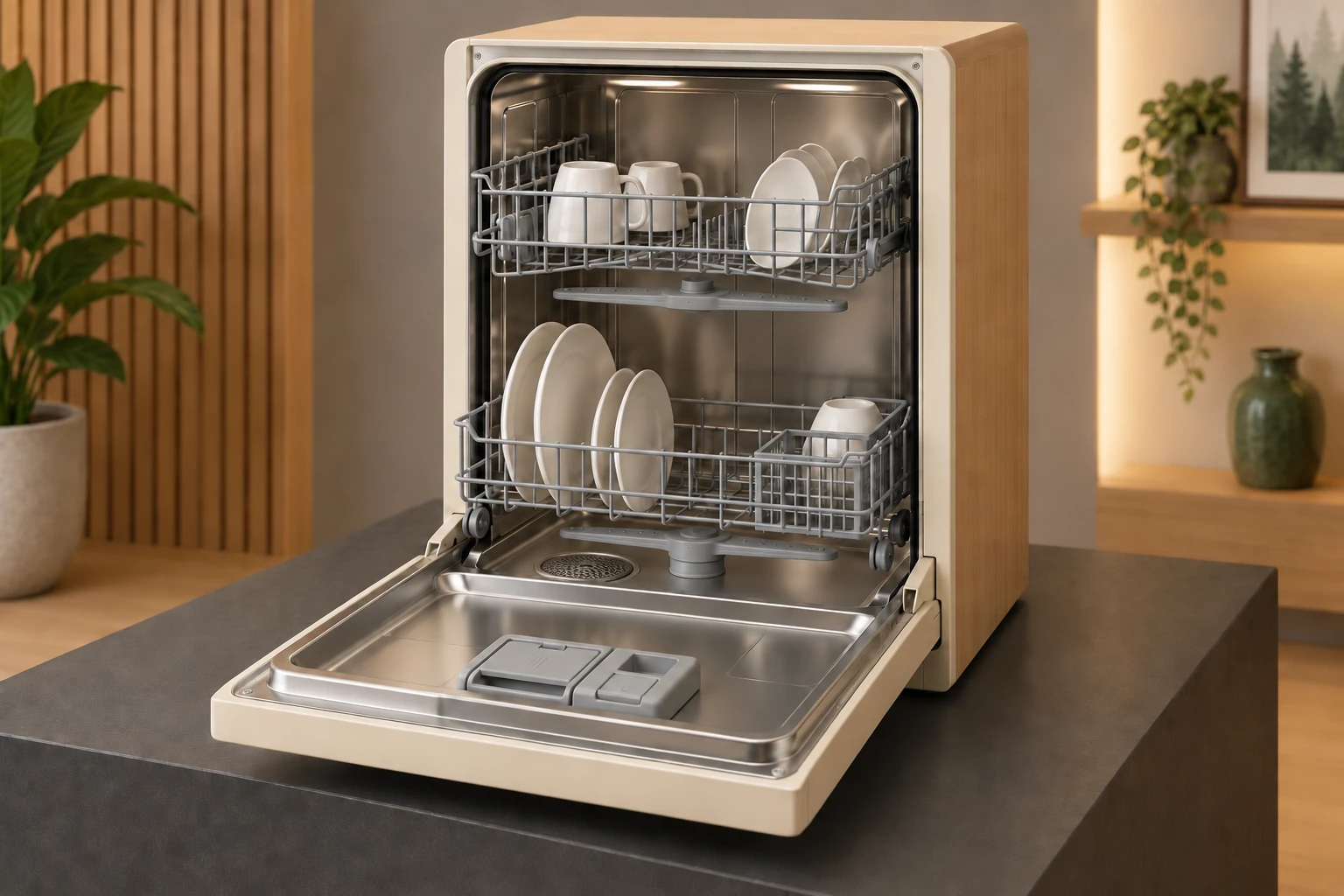
Two wire racks hold dishes inside an open metal-toned chamber. An upper arm-like form lies beneath the upper rack; a lower one lies near the floor below the lower rack. The lower arm has its own closed hub, separated from an offset mesh opening. A dispenser-like form sits on the open door.
About this illustration
No actual appliance model, concealed circulation or discharge route, pump count, filter seating, cleanliness, sensor response, spray reach or drying performance is established. The separate mesh opening is a fictional landmark, not an instruction to access a real filter or pump. This is a conceptual teaching model, not an assessment of your home.
8 picture lessons appear beside the questions in this guide. Use them to understand the explanation, then consider what it means for your home.
Four jobs inside one dishwasher
A dishwasher brings water into a chamber, uses water over the dishes, sends used water to drainage and manages moisture during drying. Those jobs have different destinations. Household supply feeds the appliance; circulation keeps water working inside it; discharge takes water out. Drying concerns water remaining on surfaces and moisture in the chamber. A machine that appears to finish a cycle has not thereby demonstrated that every plate was reached, every discharge was unobstructed or every surrounding surface remained dry. Start by naming the result you are trying to understand.
Whirlpool Canada describes washing with water and detergent, subsequent discharge and recirculated rinsing. This guide combines that general sequence with a Canada-served Bosch SHP78CM5N example for specific component and drying explanations. It is not a recommendation or identification of your model. External hoses and building drainage already have their own washer and pipe-network lessons. Here the main question is what happens inside a dishwasher—and why food remnants, water on dishware, retained water and a wet cabinet are different observations.
Separate the racks, spray landmarks and floor filter
Two wire racks hold dishes inside an open metal-toned chamber. An upper arm-like form lies beneath the upper rack; a lower one lies near the floor below the lower rack. The lower arm has its own closed hub, separated from an offset mesh opening. A dispenser-like form sits on the open door.
Numbers identify the parts explained below.
- Racks and spray landmarks
The arms and racks introduce where washing water must reach dish surfaces. The picture shows no running cycle, jets, unobstructed motion or measured washing result.
- Separate floor landmarks
The lower-arm hub and offset mesh opening remain visibly separate. Their forms do not reveal how hidden circulation, filtration or outgoing discharge actually connect.
- Door dispenser landmark
Detergent release and rinse-aid use have different documented roles. The illustrated dispenser establishes no product, dose, setting or actual release.
What does this illustration leave out?
No actual appliance model, concealed circulation or discharge route, pump count, filter seating, cleanliness, sensor response, spray reach or drying performance is established. The separate mesh opening is a fictional landmark, not an instruction to access a real filter or pump. This illustration explains an idea. It is not an installation guide.
Which part of the reported result concerns washing reach, retained water or the identified drying process?
Explore this with HomeAI ↗Opens an editable question. Nothing is sent until you choose to send it.How spray water returns to wash again
Internal circulation means water is used again within the washing process rather than every spray being a new delivery from the household pipe. Whirlpool’s physical-function explainer describes a circulation pump pushing water into spray arms. The arms distribute it over the load; water returns to the chamber’s collection and filtration area. Circulation and later discharge therefore differ in destination even though both move water. This is a conceptual role explanation, not a claim that every dishwasher has the same number, location or construction of pumps.
That distinction makes a service conversation more useful. Water entering the chamber does not prove effective spray distribution, while a reported outgoing discharge does not prove that all dish surfaces received useful washing. Household inlet conditions and the appliance’s internal circulation also need separate consideration; measuring one is not measuring the other. Describe whether the concern involves the whole load, a particular rack or a reported change after ordinary use. Do not open a running machine to watch, bypass an interlock or reach into its collection area to establish a pump diagnosis.
Separate the racks, spray landmarks and floor filter
Two wire racks hold dishes inside an open metal-toned chamber. An upper arm-like form lies beneath the upper rack; a lower one lies near the floor below the lower rack. The lower arm has its own closed hub, separated from an offset mesh opening. A dispenser-like form sits on the open door.
Numbers identify the parts explained below.
- Racks and spray landmarks
The arms and racks introduce where washing water must reach dish surfaces. The picture shows no running cycle, jets, unobstructed motion or measured washing result.
- Separate floor landmarks
The lower-arm hub and offset mesh opening remain visibly separate. Their forms do not reveal how hidden circulation, filtration or outgoing discharge actually connect.
- Door dispenser landmark
Detergent release and rinse-aid use have different documented roles. The illustrated dispenser establishes no product, dose, setting or actual release.
What does this illustration leave out?
No actual appliance model, concealed circulation or discharge route, pump count, filter seating, cleanliness, sensor response, spray reach or drying performance is established. The separate mesh opening is a fictional landmark, not an instruction to access a real filter or pump. This illustration explains an idea. It is not an installation guide.
Which part of the reported result concerns washing reach, retained water or the identified drying process?
Explore this with HomeAI ↗Opens an editable question. Nothing is sent until you choose to send it.Reuse during washing differs from later discharge.
Read the wash loop and outgoing route as separate jobs, rather than one continuous household-supply-to-sewer stream.
- Washing loop: chamber → circulation → spray → chamberWater already in the appliance is driven through the spray-arm washing function and returns within the chamber. Filtration separates soil in the documented washing system. This loop does not mean that the appliance continually receives the same amount of fresh household water.
- Changing water within the chosen cycleThe identified Bosch manual describes water-quality sensing and program-dependent water replacement. A chosen cycle can contain washing, draining and rinsing phases; no fixed phase timing or universal sensor behaviour is supplied.
- Outgoing route: appliance → discharge hose → receiving drainageUsed water leaves through the appliance’s outgoing route and meets the building drainage arrangement. Circulation while washing and evacuation after a phase answer different questions; a successful-looking spray landmark does not establish discharge.
- Receiving arrangement needs its own identityThe Canada-served installation document illustrates more than one drain arrangement and retains local requirements. Sink proximity and a generic hose photograph do not identify the actual receiving route or approve a connection.
Conceptual roles only: no installed layout, pump count, water volume, hose height, connection or test procedure. The still picture does not expose these hidden paths.
Whirlpool Canada · Guide to Using a Dishwasher, Whirlpool · How Does a Dishwasher Work on the Inside? (US physical-function supplement), Bosch · SHP78CM5N Use and Care Manual, 9001641455_C (Canada-served 9001641455_C) and Bosch · Dishwasher Installation Instructions, 9001831461_A (Canada-served 9001831461_A). Reviewed October 4, 2026; named sources are not a national plumbing rule.
What the filter does—and what it does not
Filtration separates material from the water being used. The named Bosch manual identifies coarse, fine and micro-filter components; their shared role is keeping soiling from continuing through the wash process. Whirlpool explains filtration as protecting the circulation route from food-particle accumulation. Think of separation and transport as different functions: retaining particles at a filter is not the same job as sending liquid through an outgoing hose. A filter-like shape in a cutaway can teach that distinction without showing its seating, condition or the concealed connected route.
A cleaning complaint can involve filtration, spray reach, products or cycle choice. Retained water can involve another part of the outgoing route or an unfinished cycle. These alternatives explain why “it needs a filter” is too large a conclusion from a dirty plate or water photograph. Find the relevant care information in the matching owner document and ask the service provider which function needs assessment. This lesson provides no filter-removal, pump-cover, impeller or spray-arm manipulation. It also supplies no universal cleaning interval or chemical remedy.
Separate the racks, spray landmarks and floor filter
Two wire racks hold dishes inside an open metal-toned chamber. An upper arm-like form lies beneath the upper rack; a lower one lies near the floor below the lower rack. The lower arm has its own closed hub, separated from an offset mesh opening. A dispenser-like form sits on the open door.
Numbers identify the parts explained below.
- Racks and spray landmarks
The arms and racks introduce where washing water must reach dish surfaces. The picture shows no running cycle, jets, unobstructed motion or measured washing result.
- Separate floor landmarks
The lower-arm hub and offset mesh opening remain visibly separate. Their forms do not reveal how hidden circulation, filtration or outgoing discharge actually connect.
- Door dispenser landmark
Detergent release and rinse-aid use have different documented roles. The illustrated dispenser establishes no product, dose, setting or actual release.
What does this illustration leave out?
No actual appliance model, concealed circulation or discharge route, pump count, filter seating, cleanliness, sensor response, spray reach or drying performance is established. The separate mesh opening is a fictional landmark, not an instruction to access a real filter or pump. This illustration explains an idea. It is not an installation guide.
Which part of the reported result concerns washing reach, retained water or the identified drying process?
Explore this with HomeAI ↗Opens an editable question. Nothing is sent until you choose to send it.Why loading changes where water can reach
A spray system needs a route to the soiled surface. Two nested bowls can shield the surfaces between them; an item projecting into an arm’s travel can interfere with distribution. The chamber being full of dishes is therefore different from the load being reachable by the intended spray. The named documents also consider stable positioning and openings or recesses that can retain water. These are spatial relationships: an arm, rack, surface and neighbouring item have to work together. Rack count or a third-rack photograph does not describe every load.
After an ordinary completed cycle, when the appliance and dishware are safe to view under its instructions, note where food remnants or collected water were found. Was the account about a tall container, closely arranged items or a changed loading pattern? Keep those as questions rather than proof of inadequate pump force. Match future ordinary use to the actual loading guidance and dishware labels. Do not rotate parts manually as a test, force a rack or open during spraying. A view of the load cannot establish hidden component condition or verify cleaning and sanitation performance.
Separate the racks, spray landmarks and floor filter
Two wire racks hold dishes inside an open metal-toned chamber. An upper arm-like form lies beneath the upper rack; a lower one lies near the floor below the lower rack. The lower arm has its own closed hub, separated from an offset mesh opening. A dispenser-like form sits on the open door.
Numbers identify the parts explained below.
- Racks and spray landmarks
The arms and racks introduce where washing water must reach dish surfaces. The picture shows no running cycle, jets, unobstructed motion or measured washing result.
- Separate floor landmarks
The lower-arm hub and offset mesh opening remain visibly separate. Their forms do not reveal how hidden circulation, filtration or outgoing discharge actually connect.
- Door dispenser landmark
Detergent release and rinse-aid use have different documented roles. The illustrated dispenser establishes no product, dose, setting or actual release.
What does this illustration leave out?
No actual appliance model, concealed circulation or discharge route, pump count, filter seating, cleanliness, sensor response, spray reach or drying performance is established. The separate mesh opening is a fictional landmark, not an instruction to access a real filter or pump. This illustration explains an idea. It is not an installation guide.
Which part of the reported result concerns washing reach, retained water or the identified drying process?
Explore this with HomeAI ↗Opens an editable question. Nothing is sent until you choose to send it.Detergent release is different from rinse aid
The detergent dispenser introduces a cleaning product at the intended part of the cycle. Its timing and access matter: the product being present in a compartment is different from it being delivered and dissolved effectively. The named owner document discusses interrupted access to the dispenser and residues with several possible explanations. Rinse aid has a different role. Bosch Canada explains that it reduces water’s surface tension, helping water run off dish surfaces. Cleaning chemistry, delivery and water runoff therefore belong to related but separate questions.
Record the identified product and ordinary selected cycle when discussing a result. Detergent residue, food residue and dried water spots are different descriptions; a single photograph need not distinguish them. Use the appliance and product instructions for suitability, rather than substituting ordinary hand dish soap or improvising combinations. This guide gives no dose, dispenser setting, cleaner selection or descaling procedure. For persistent changed results, ask qualified appliance service which part of delivery, washing or drying their assessment addresses. A refill indicator supplies information about a named function, not a whole-appliance condition finding.
Separate the racks, spray landmarks and floor filter
Two wire racks hold dishes inside an open metal-toned chamber. An upper arm-like form lies beneath the upper rack; a lower one lies near the floor below the lower rack. The lower arm has its own closed hub, separated from an offset mesh opening. A dispenser-like form sits on the open door.
Numbers identify the parts explained below.
- Racks and spray landmarks
The arms and racks introduce where washing water must reach dish surfaces. The picture shows no running cycle, jets, unobstructed motion or measured washing result.
- Separate floor landmarks
The lower-arm hub and offset mesh opening remain visibly separate. Their forms do not reveal how hidden circulation, filtration or outgoing discharge actually connect.
- Door dispenser landmark
Detergent release and rinse-aid use have different documented roles. The illustrated dispenser establishes no product, dose, setting or actual release.
What does this illustration leave out?
No actual appliance model, concealed circulation or discharge route, pump count, filter seating, cleanliness, sensor response, spray reach or drying performance is established. The separate mesh opening is a fictional landmark, not an instruction to access a real filter or pump. This illustration explains an idea. It is not an installation guide.
Which part of the reported result concerns washing reach, retained water or the identified drying process?
Explore this with HomeAI ↗Opens an editable question. Nothing is sent until you choose to send it.A chosen cycle is a sequence, not a fixed timer
A cycle can include washing, intermediate rinsing, final rinsing and drying, with available options changing parts of that sequence. The identified Bosch example also uses an optical measure of the washing water’s turbidity: the control considers soiling when deciding water replacement and other cycle behaviour. It is measuring a property of the water, not visually certifying each plate. The selected program, load and operating conditions matter together. A remaining-time display or familiar program name is useful context, but it is not a measurement of spray reach or clean dishware.
Keep the actual program and options beside the observation instead of comparing every load against a universal duration. A changed elapsed time may be relevant without identifying a failed heater, sensor or pump. Likewise, a drying option is not a guarantee that a recessed cup contains no drops. Check what the matched document says the selected functions are intended to do. This guide gives no program reset, sensor adjustment, forced cycle or temperature experiment. It also makes no sanitization, water-use or energy-performance claim from a label, elapsed time or completion light.
Draining hands water to the building system
When discharge occurs, water leaves through the appliance’s outgoing route and meets building drainage. This handoff differs from water circulating within the chamber. The reviewed installation manual depicts different receiving arrangements and raises model-specific hose routing and local requirements. A nearby sink makes the relationship easier to imagine, but proximity does not prove the actual connection. Internal draining, hose condition and the receiving plumbing remain related questions with different assessment access. The household supply is another route entirely.
If the issue is retained water, the service provider can explain whether their proposed scope concerns appliance operation, its connected outgoing route or receiving plumbing. Ask how a reported installation change affects that choice. Do not pull a built-in machine out, disconnect a hose, inspect behind wet energized equipment or intentionally reproduce a suspect discharge. The named manual’s alternatives do not establish a universal high-loop or air-gap requirement for Canadian kitchens. Use current matched instructions and local qualified advice; follow the separate plumbing guide when the concern reaches the building network.
A closed appliance meets a larger kitchen system
A closed built-in appliance sits beside a closed sink cabinet in a timber and cream kitchen. The sink, tap, countertop and paper-like objects with no readable document content locate the ordinary room context.
Numbers identify the parts explained below.

- Closed appliance
The visible face locates the appliance. Its washing, controls, outgoing water and named drying functions require the actual equipment identity and a matched service question.
- Sink and cabinet context
The kitchen contains supply, drainage and electrical interfaces with their own scope. None of those concealed routes is established by this closed-cabinet picture.
- Actual records still needed
The paper-like objects introduce document questions only. Existing model details, dated observations and the provider’s stated assessment scope supply the useful evidence.
What does this illustration leave out?
No supply hose, outgoing hose, receiving drain, electrical connection, leak, actual manual text, installed model, drying chamber or hidden airflow is visible. Sink proximity supplies no connection or local approval finding; the paper-like objects are not completed records. This illustration explains an idea. It is not an installation guide.
Does the question belong to the appliance, the receiving building system or an affected surrounding area?
Explore this with HomeAI ↗Opens an editable question. Nothing is sent until you choose to send it.Condensation can leave a wet tub after dishes dry
Drying does not necessarily mean every interior surface becomes dry at the same moment. In the named condensation explanation, moisture in the chamber can form droplets on interior surfaces, run down and be discharged. The Bosch owner manual explicitly distinguishes this interior wetness from a dishware drying complaint. Water located on a wall, in a cup’s recess and pooled at the bottom describes different places. Identifying the location is more useful than treating all three as one sign of either a good appliance or a failed drain.
Condensation is a model-specific explanation to check, not permission to dismiss any retained water. Whether the selected cycle finished, what surfaces were wet and what the actual instructions describe remain relevant. Steam or hot water can escape when a dishwasher is opened; ordinary observations must respect its safe-use instructions rather than interrupt the cycle. Moisture outside the cabinet boundary is a separate concern. The named owner document warns about escaping vapour affecting cabinetry, but an affected surface cannot identify vapour as the cause or rule out a liquid leak.
Separate the racks, spray landmarks and floor filter
Two wire racks hold dishes inside an open metal-toned chamber. An upper arm-like form lies beneath the upper rack; a lower one lies near the floor below the lower rack. The lower arm has its own closed hub, separated from an offset mesh opening. A dispenser-like form sits on the open door.
Numbers identify the parts explained below.
- Racks and spray landmarks
The arms and racks introduce where washing water must reach dish surfaces. The picture shows no running cycle, jets, unobstructed motion or measured washing result.
- Separate floor landmarks
The lower-arm hub and offset mesh opening remain visibly separate. Their forms do not reveal how hidden circulation, filtration or outgoing discharge actually connect.
- Door dispenser landmark
Detergent release and rinse-aid use have different documented roles. The illustrated dispenser establishes no product, dose, setting or actual release.
What does this illustration leave out?
No actual appliance model, concealed circulation or discharge route, pump count, filter seating, cleanliness, sensor response, spray reach or drying performance is established. The separate mesh opening is a fictional landmark, not an instruction to access a real filter or pump. This illustration explains an idea. It is not an installation guide.
Which part of the reported result concerns washing reach, retained water or the identified drying process?
Explore this with HomeAI ↗Opens an editable question. Nothing is sent until you choose to send it.One model’s mineral-assisted drying route
The identified Bosch model describes a Zeolite container that takes up moisture during drying and releases heat. Bosch Canada’s CrystalDry explanation follows internal moist air through an intake and fan into a chamber, then returns warmer dry air to the tub. During washing, energy is also used to dry the mineral for a later drying phase. This adds a specific moisture-and-heat relationship to the appliance explanation. The air route is different from the hose carrying liquid discharge to the building drain.
A named feature therefore requires its own matched description. It should not become “all dishwashers use minerals,” “all drying uses outside air” or a universal exposed-heater arrangement. Nor does a fan-shaped or chamber-shaped teaching specimen identify the material, air direction or working condition of an installed machine. Ask what drying system the actual model has and what its selected functions cover. The reviewed sources support this branded example without supplying a temperature, improvement percentage, repair recipe or performance assurance for your load. Drying hardware does not replace the outgoing-water question.
Interior condensation and mineral-assisted drying have different roles.
These sourced relationships describe the identified Bosch example. The chamber still does not reveal the hidden mineral container or its actual airflow.
- Condensation: dish moisture → interior surface → runoffBosch’s named condensation explanation describes moisture leaving warm dish surfaces, condensing on the interior and draining away. Interior droplets can therefore have a drying explanation without establishing that every wet area or retained pool is acceptable.
- Mineral-assisted air route: tub → intake and fan → mineral chamber → tubThe Canadian manufacturer describes moist internal air directed into a mineral chamber. Moisture uptake releases heat, and warmer dry air returns through the outlet to assist dish drying. No outside-air route is inferred.
- Later washing prepares the mineral for another drying phaseThe named explanation describes recharging during the next wash. Keep this later washing phase distinct from the drying-air return; this is not a universal cycle timeline.
- A result still depends on the actual equipment and conditionsLoading, chosen options and water runoff can affect reported drying. An interior droplet, wet plastic recess, standing retained water and escaped cabinet moisture need separately scoped questions.
Named conceptual mechanisms, not every dishwasher’s design. No temperature, drying percentage, chemical recipe, hidden geometry, adjustment or normal-water clearance is supplied.
Bosch · SHP78CM5N Use and Care Manual, 9001641455_C, Bosch Canada · Dishwasher FAQs and condensation drying and Bosch Canada · CrystalDry physical-function explanation. Complete scoped bodies reviewed October 4, 2026; manufacturer marketing performance claims are not adopted.
Separate cleaning, retained water and escaped moisture
Organize a changed result by what was actually noticed. Food remnants raise questions about washing reach, the load, product delivery, cycle and component condition. Interior droplets raise the actual drying-system context. Water remaining at the bottom has its own cycle-completion and outgoing-route questions. Wet cabinet flooring concerns water outside the intended chamber. Several observations can occur together without sharing one proven cause. Notes from ordinary use can preserve location, timing and recurrence, while leaving the source and inaccessible areas unresolved.
Safety comes before further observation. Stay away from wet electrical surroundings; ESA explains that electricity can move through water and wet flooring. Do not cross a wet area to reach plugs, switches or a panel, and seek appropriate utility or qualified help when electrical systems may be affected. Do not operate a suspected leak to improve the evidence, remove covers or tip the appliance. Once safe, give the appropriate provider the existing account. An appliance repair and assessment of affected building materials may require different scope; neither is established by a normal-looking exterior.
Choose the service question and local installation scope
Keep the actual model and production identity with its matching owner and installation documents. Ask appliance service about internal washing or drying; ask the qualified installation/plumbing team about changed connections and receiving drainage; use appropriate electrical help for electrical concerns. The provider should explain which question their proposed assessment addresses. An installer’s recorded operating and leak check concerns the stated conditions and accessible extent at that time. It does not prove every hidden route, future operation or the condition of the entire kitchen.
These sources include a Canada-served English owner manual marked2026 and installation instructions marked2023. Their numerical supply details differ, so this guide adopts none and does not reconcile them for your appliance. Calgary’s municipal guidance shows why alteration, eligibility and inspection scope need local questions; it establishes no Canadian dishwasher exemption. Shared-property work also needs the relevant authorized building contacts. For an appliance in a freeze-exposed vacant location, the named owner document calls for professional winterizing. Obtain matched advice without treating a national climate label as a procedure or universal service interval.
A closed appliance meets a larger kitchen system
A closed built-in appliance sits beside a closed sink cabinet in a timber and cream kitchen. The sink, tap, countertop and paper-like objects with no readable document content locate the ordinary room context.
Numbers identify the parts explained below.
- Closed appliance
The visible face locates the appliance. Its washing, controls, outgoing water and named drying functions require the actual equipment identity and a matched service question.
- Sink and cabinet context
The kitchen contains supply, drainage and electrical interfaces with their own scope. None of those concealed routes is established by this closed-cabinet picture.
- Actual records still needed
The paper-like objects introduce document questions only. Existing model details, dated observations and the provider’s stated assessment scope supply the useful evidence.
What does this illustration leave out?
No supply hose, outgoing hose, receiving drain, electrical connection, leak, actual manual text, installed model, drying chamber or hidden airflow is visible. Sink proximity supplies no connection or local approval finding; the paper-like objects are not completed records. This illustration explains an idea. It is not an installation guide.
Does the question belong to the appliance, the receiving building system or an affected surrounding area?
Explore this with HomeAI ↗Opens an editable question. Nothing is sent until you choose to send it.A fictional owner separates three observations
Explicitly fictional learning case: an invented Canadian owner reports food remnants on closely arranged upper-rack items after ordinary use. Their saved account names the selected program and product, but contains no spray or component assessment. A later completed cycle leaves interior droplets; the actual drying system has not yet been identified. On another occasion they notice wet cabinet flooring near the appliance. These invented observations establish neither a shared cause nor a failed pump. The third observation introduces a separate safety and source question rather than proving the earlier cleaning complaint caused a leak.
The fictional owner avoids further operation to recreate the wet area and keeps clear of potentially affected electrical surroundings. When safe, their handoff has three entries: where food remained and under which ordinary circumstances; where interior droplets were seen with cycle completion stated; and the first visible external wet location and time. Qualified advice can then choose appliance, connection or affected-area scope and obtain the matching model documents. No repair, normality finding, approval or permanent dryness is invented. The useful outcome is a clearer assignment: explain the actual drying system, assess the reported washing result and safely address the separate external-water question.
Keep learning about the connected parts
Practice the distinction.
Three dishwasher observations without one invented cause
Explicitly fictional Canadian owner and appliance: upper-rack food remnants, later interior droplets and a separate wet cabinet area are recorded after ordinary use; the actual drying system and causes remain unresolved.
Reported observations
- Food remained on closely arranged upper-rack items in the invented account, with selected program and product recorded.
- A later cycle is described as completed with interior droplets, without matched drying-system identification.
- Wet cabinet flooring was noticed on another occasion, without a confirmed point of emergence.
- No appliance, plumbing, electrical or affected-material assessment has supplied a cause or clearance.
Compare the explanations
Expand each possibility to see the evidence needed to distinguish it. Similar symptoms can have different mechanisms.
The washing and drying explanations may differ
Loading, product delivery, cycle and component questions may address food remnants, while the actual drying system may explain some interior wetness.
The matching model documents and appropriately scoped interpretation of the original ordinary-use account, without a staged operating test.
External water needs its own safe investigation
The wet cabinet location does not identify a liquid or vapour source, prove a pump fault or show that the earlier observations caused it.
Qualified source and affected-area assessment with actual findings, access and electrical safety limits retained.
A useful next question
Keep clear of potentially affected electrical surroundings, avoid reproducing the wet event and hand off the existing observations to providers matched to appliance, connected plumbing and affected-area questions.
No actual property, failed component, shared cause, normality, approved installation, available provider, repair outcome, cost or permanent dryness is supplied.
Know what the words mean.
- Dishwasher circulation
- The internal reuse of water through the washing process, kept distinct from household inlet delivery and outgoing discharge.
- Dishwasher spray arm
- An identified component distributing wash water over dishware in its designed arrangement; its appearance alone does not establish reach or operation.
- Dishwasher filtration
- Separation of soiling from water used in the washing process, with product-specific components and care instructions.
- Dishwasher detergent delivery
- Introduction of the appropriate cleaning product into the intended part of the cycle, separate from merely having product in a compartment.
- Dishwasher rinse aid
- A product with a water-runoff role described by the manufacturer, distinct from the washing detergent and governed by matched instructions.
- Dishwasher discharge
- Water leaving the appliance’s internal process through its outgoing route toward the receiving building drainage.
- Condensation drying
- A named drying process in which chamber moisture forms droplets on interior surfaces and can run off; not a universal explanation for standing or escaped water.
- Zeolite drying example
- The identified model’s mineral moisture-uptake and heat-release relationship with an internal air route, not a feature inferred for every dishwasher.
- Dishwasher cycle context
- The actual program, options, ordinary load and operating circumstances attached to an observation rather than a universal timer or performance finding.
- Appliance check scope
- The question, operating conditions, accessible extent, date and limitations of an actual installation or service check; not permanent whole-system clearance.
Questions to bring
to the conversation.
- Does the question concern water entering, circulating inside, leaving the appliance or remaining on surfaces during drying?
- Which actual model and instruction revision establish the component and drying functions being discussed?
- Where on the ordinary load was the changed result noticed, and which program, options and product were recorded?
- Is the observation food residue, detergent residue, interior droplets, retained water or escaped cabinet/floor moisture?
- Which proposed assessment addresses internal appliance functions, connected outgoing drainage or receiving building plumbing?
- What conditions and accessible extent did an actual installation or service check cover, and what remains unresolved?
- Which local authority and qualified provider can clarify changed installation, shared-property or freeze-exposed storage scope?
- Can the question be handed off from existing safe observations without operating a suspect leak, moving equipment or opening components?
Separate a showing observation, an existing record and a new professional assessment. Unknown means a question remains; it does not automatically mean a defect.
Use the evidence planner ↗Go to the source.
Original HomeAI explanation informed by these public references. Sources support the underlying guidance; they have not reviewed or endorsed HomeAI. Diagrams are conceptual, and calculator outputs depend on your inputs.
Publication & source review
First published .
Sources reviewed .
- Bosch Canada · SHP78CM5N/01 model and manual support
Where this reference applies
Jurisdiction: Canadian exact-model manufacturer support index; not identification of a reader’s installed appliance
Edition: No substantive page date established. Current owner/installation link association observed October4,2026UTC.
Source reviewed: 2026-10-04 · UTC
Canadian-market example and manufacturer association with the captured owner and installation manuals. No stock, price, recommendation, available service or installed-reader-model claim.
- Bosch · SHP78CM5N Use and Care Manual, 9001641455_C
Where this reference applies
Jurisdiction: English en-us manual currently linked by Bosch Canada for SHP78CM5N/01; named physical-function example, not Canadian law
Edition: Footer©2026;9001641455(060730)650A5. PDF metadata creation/modification2026-07-30 retained separately, not asserted as formal publication or code adoption.
Source reviewed: 2026-10-04 · UTC
Spray/filter/dispenser functions, sensor-dependent water replacement, cycle/options, condensation and named Zeolite drying, alternative observations, identity/service/freezing context. Conflicting numerical installation values, settings/reset/remote operation, filter/pump/arm manipulation, doses/chemicals, moving/winterizing procedures, performance/sanitization/energy ratings and warranty outcomes excluded.
- Bosch · Dishwasher Installation Instructions, 9001831461_A
Where this reference applies
Jurisdiction: English instructions currently linked by Bosch Canada for the named model, with retained fr-ca/es-mx sections; manufacturer instructions are not law
Edition: Footer©2023;9001831461(030426)650AUS en-us,fr-ca,es-mx. PDF metadata2023-04-26 is not code-adoption or installed-revision proof.
Source reviewed: 2026-10-04 · UTC
Qualified installation/plumbing/electrical scope, separate routes, model/local drain arrangements, compatibility/secure placement and installer operating/leak-check scope. All numerical requirements, installation/wiring/mounting/adjustment/test recipes, universal high-loop/air-gap rules and code certification excluded.
- Bosch Canada · CrystalDry physical-function explanation
Where this reference applies
Jurisdiction: Canadian manufacturer branded drying-system explanation; not a universal dishwasher configuration
Edition: No substantive article publication/update date established. Marketing study dates are not an article edition.
Source reviewed: 2026-10-04 · UTC
Internal moist-air intake, fan/chamber, mineral moisture uptake with heat release, dry-air return and regeneration during later washing. No temperature, improvement percentage, ranking, guarantee, mineral identification from a picture or retrofit recipe.
- Bosch Canada · Dishwasher FAQs and condensation drying
Where this reference applies
Jurisdiction: Canadian manufacturer named condensation-system explanation; broader family FAQs do not identify a reader’s model
Edition: No substantive article date established. Fresh reading is not a new instruction revision.
Source reviewed: 2026-10-04 · UTC
Named condensation explanation, rinse-aid surface-tension/runoff role and model/receipt identity. All-model/plastic guarantees, general material cooling-rate law, sanitization figures, maintenance intervals, error/reset/cleaning recipes and support availability excluded.
- Whirlpool Canada · Guide to Using a Dishwasher
Where this reference applies
Jurisdiction: Canadian manufacturer general cycle explanation; not an exact-model manual or national requirement
Edition: No substantive article date established. ©2026 footer is not a publication date.
Source reviewed: 2026-10-04 · UTC
Water entry, detergent circulation during washing, discharge and recirculated rinsing, loading and selected-cycle considerations. No numbers, doses, portable connections, chemical recommendations, universal heated-dry configuration or product/service claims.
- Whirlpool · How Does a Dishwasher Work on the Inside?
Where this reference applies
Jurisdiction: US manufacturer physical-function supplement, paired with Canadian cycle explanation and Canada-served model manuals; not Canadian identity or law
Edition: No substantive article date established. ©2026 footer is not publication proof.
Source reviewed: 2026-10-04 · UTC
Circulation pump feeding spray arms, filtration protecting circulation and separate outgoing hose/rinse/discharge roles. No universal float/pump count/heater/receiving-disposal arrangement, numbers, door-open/filter/connection recipe or US requirements applied to Canada.
- Electrical Safety Authority · Flood safety
Where this reference applies
Jurisdiction: Ontario electrical regulator; physical wet-electricity hazard guidance with Ontario processes kept local
Edition: No substantive publication/update date established; transport date is not an article edition.
Source reviewed: 2026-10-04 · UTC
Electricity can travel through water or wet flooring; keep away from wet electrical surroundings and seek appropriate utility/qualified help. No owner isolation/reconnection/repair procedure, clearance numbers, insurance promise or Ontario licensing process nationalized.
- City of Calgary · Homeowner electrical and plumbing permits
Where this reference applies
Jurisdiction: Calgary, Alberta municipal guidance; not national appliance requirements or legal opinion
Edition: No substantive page date established. Transport dates are not edition proof; final disclaimer says no legal status or official interpretation.
Source reviewed: 2026-10-04 · UTC
Local alteration, qualified-provider, shared-property and inspection questions. No dishwasher-specific exemption, fees/numbers, universal permits/licensing, owner procedure, code adoption or compliance finding.
Have a question about your home?
Start with the symptom, timing and what you have observed.
Ask HomeAI